Dynamics 365 Business Central – How to change the VAT amount on a Purchase Invoice or Purchase Order

Introduction

Sometimes, when entering a Purchase Invoice from a supplier into Business Central, the system calculates the VAT slightly differently than what appears on the supplier’s invoice.

When this happens we need to change the VAT on the Purchase Invoice in Business Central to reflect the suppliers Invoice.

In this post we’ll go through how to do this when raising the Purchase Invoice via the “Purchase Order” page and also the “Purchase Invoice” page.

First a little Config

Before we do this we must first configure Business Central to allow us to change the VAT on documents and journals.

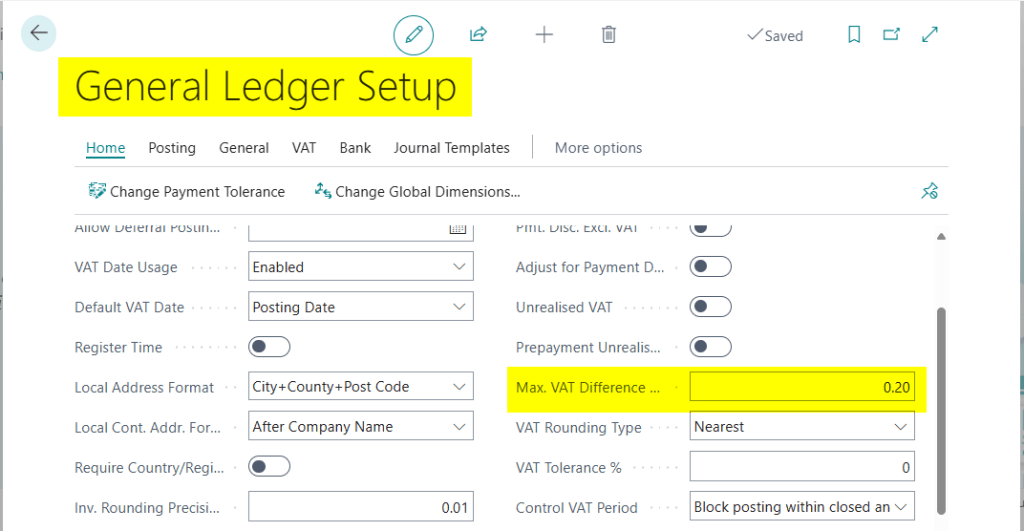
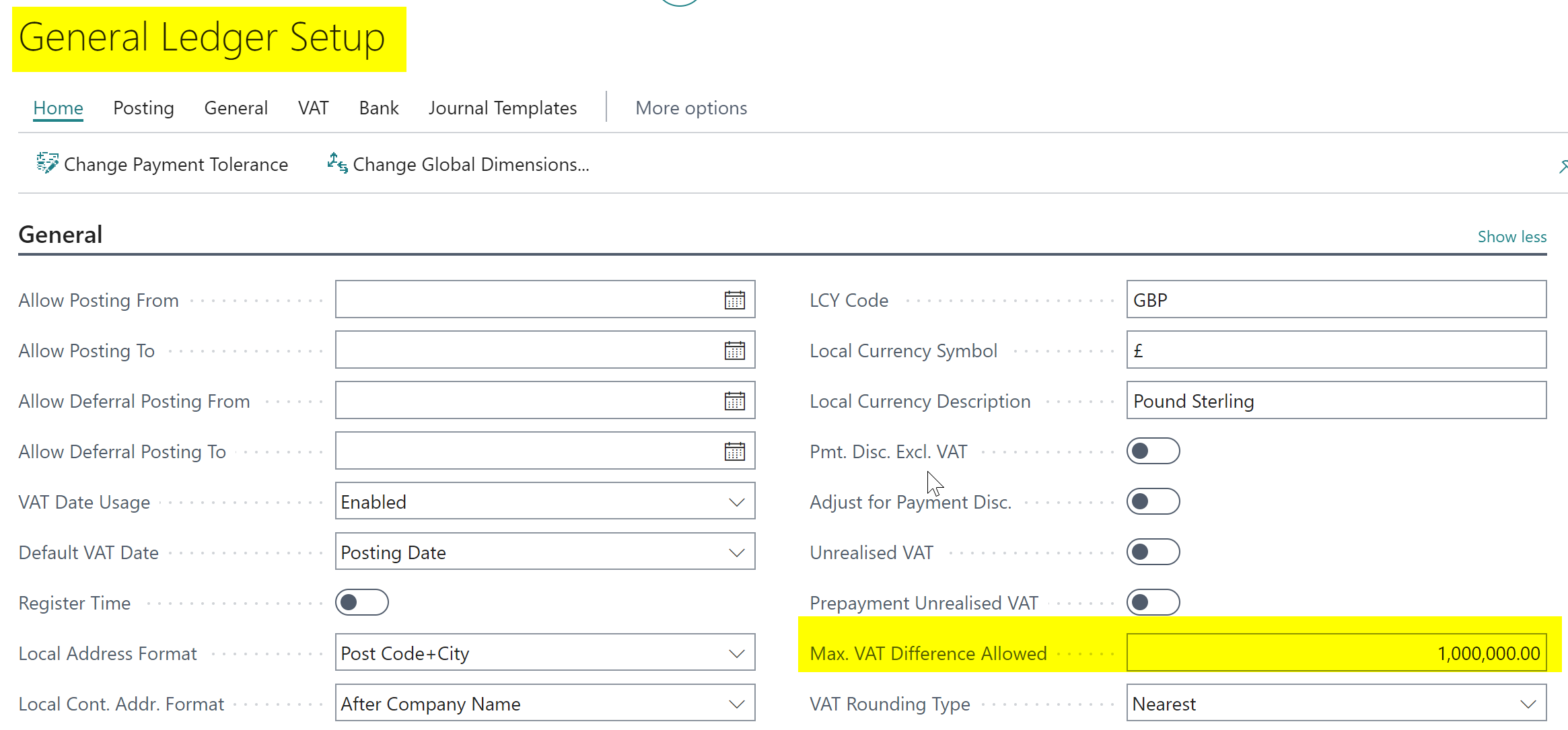
We first do this by setting the “Max. VAT Difference Allowed” in the General Ledger Setup. I’m going to set this to 0.20 which means I’m allowed to change the VAT by up to £0.20p
Next I need to switch the “Allow VAT Difference” option ON in the “Purchase & Payables Setup” page. This will allow me to change the VAT amount on a Purchase transaction.
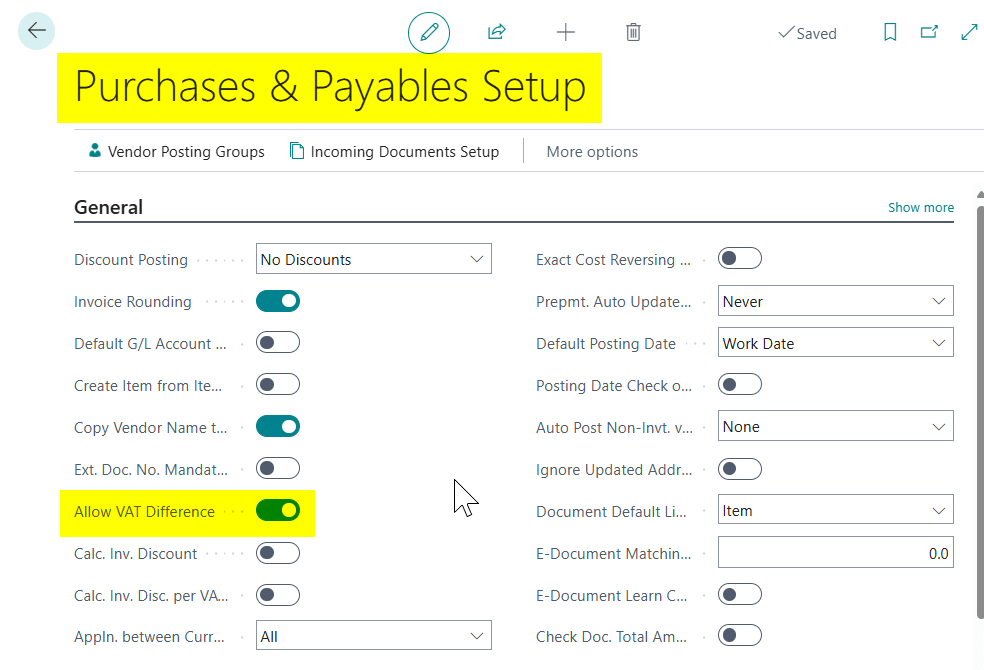
Now I have the configuration setup, we can go through changing the VAT on a Purchase transaction.

First we’ll tackle a Purchase Invoice entered via the “Purchase Invoice” page.

Changing VAT in the Purchase Invoice page

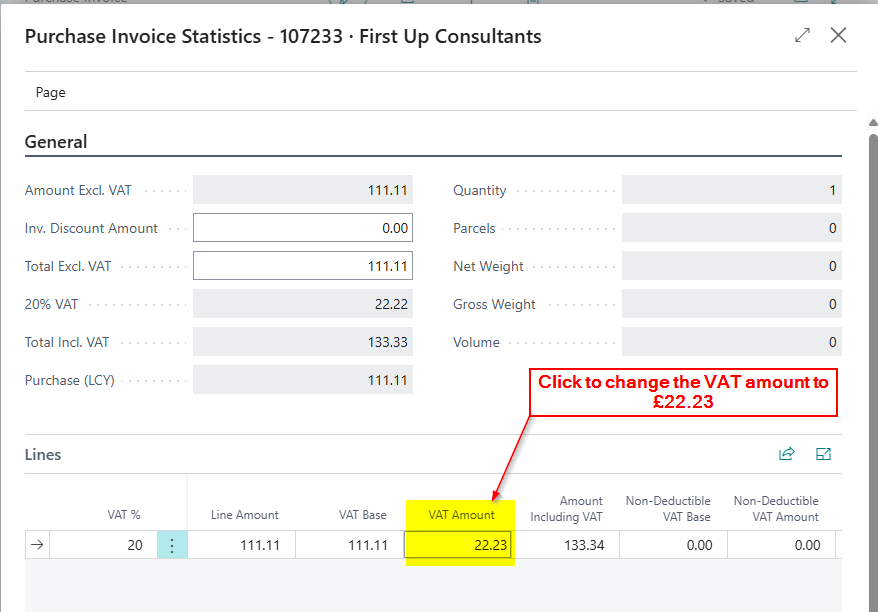
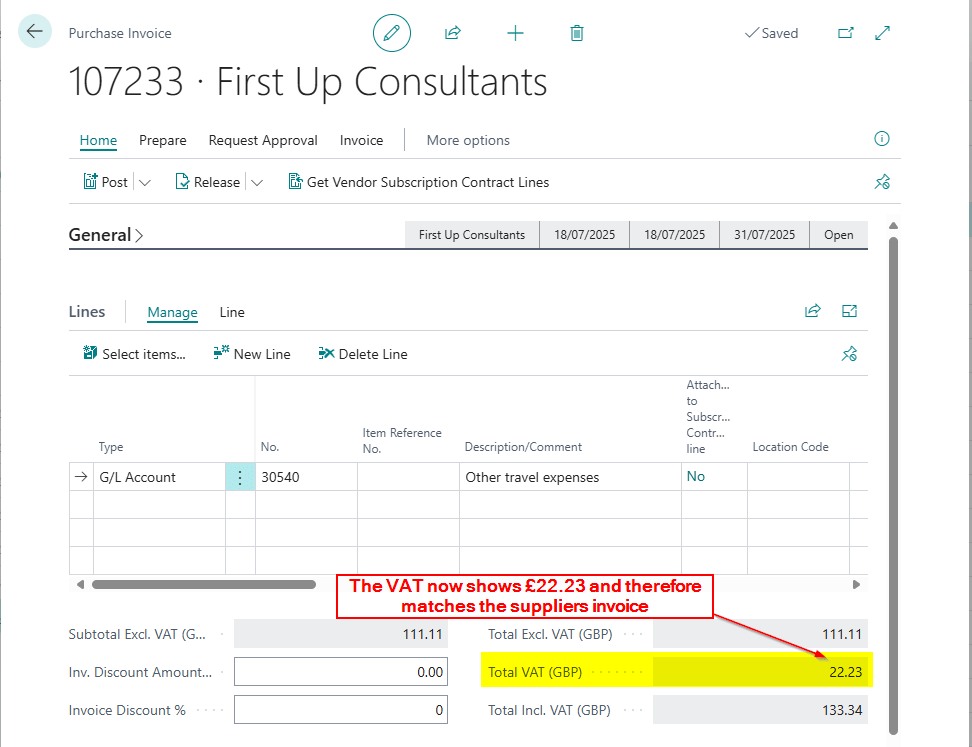
In this scenario, we have a Purchase Invoice for £111.11 with 20% VAT, and Business Central has calculated the VAT as £22.22. However, the supplier’s invoice shows a VAT amount of £22.23. We therefore need to change the VAT to reflect the suppliers invoice correctly in Business Central.

Below is the Purchase Invoice with the VAT calculated as £22.22.
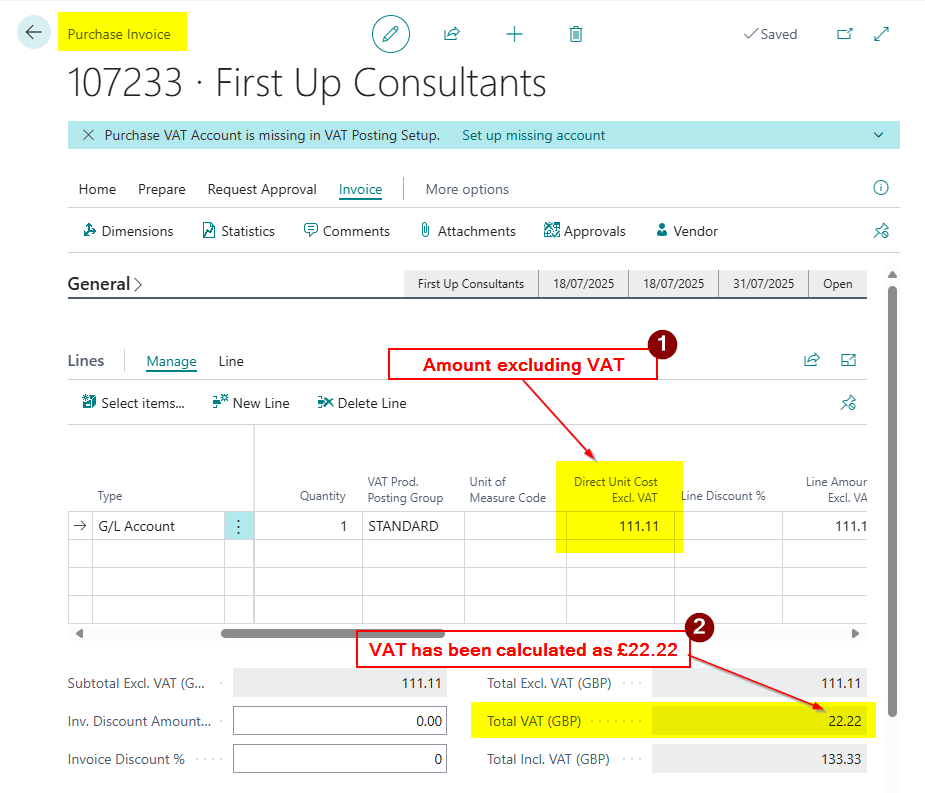
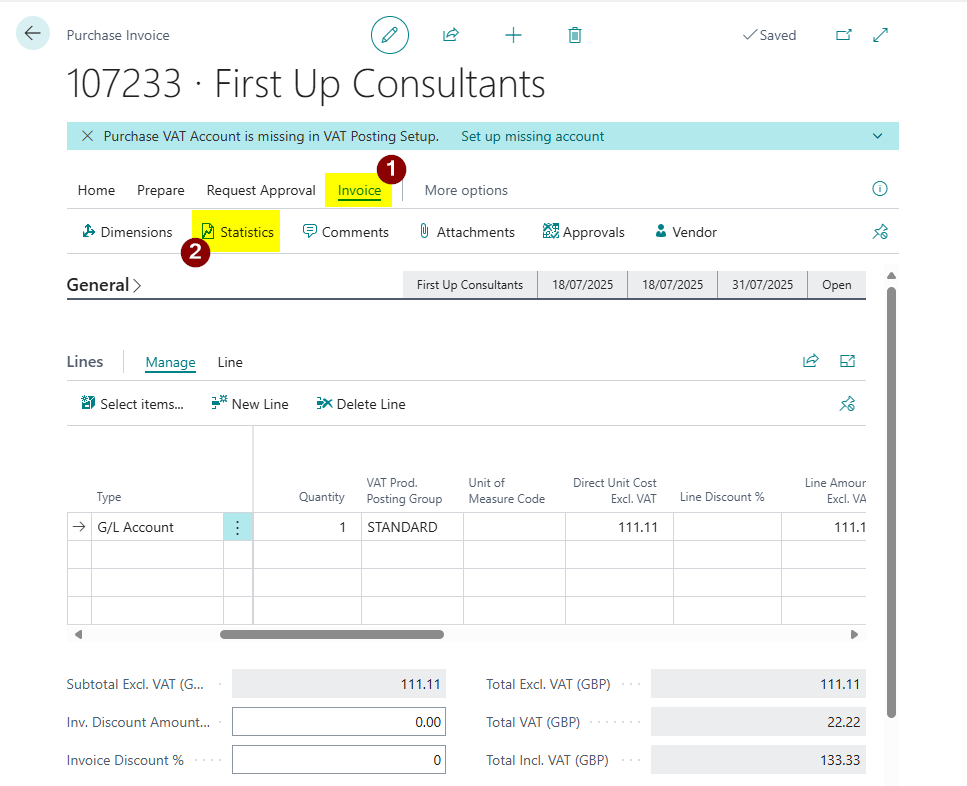
To change the VAT I need to click “Invoice > Statistics”
I then click into the VAT Amount and change it to £22.23 which matches the suppliers invoice
The VAT is now reflected correctly in Business Central
Changing VAT on the Purchase Order page

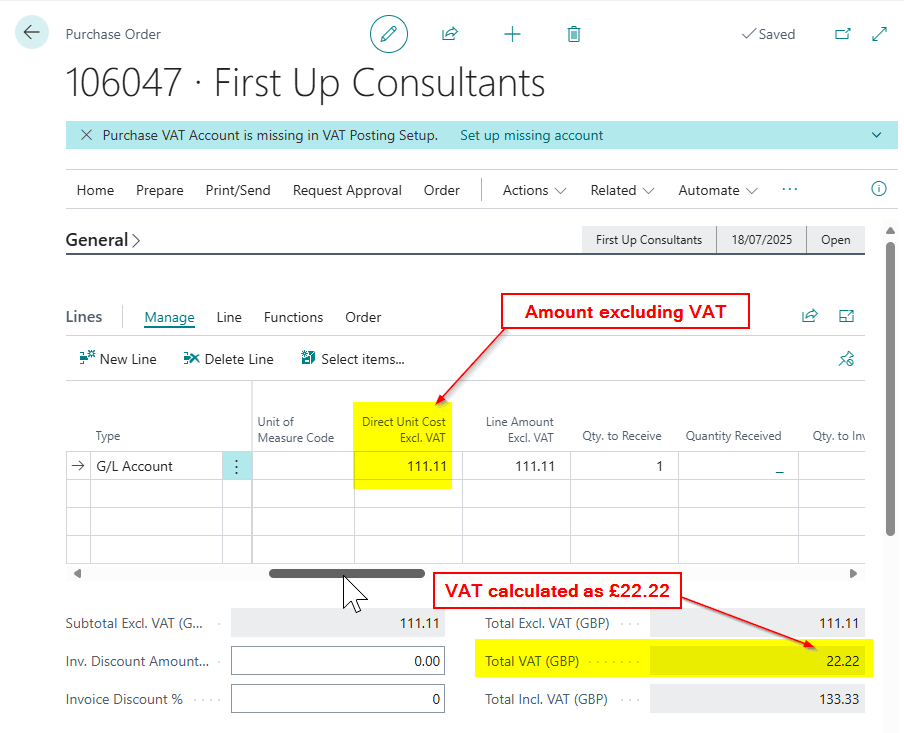
Suppose you’re entering the same Purchase Invoice, however this time we are using the “Purchase Order” page to raise the Purchase Invoice. In this case we need to do the following

Below is the Purchase Order with the VAT calculated as £22.22
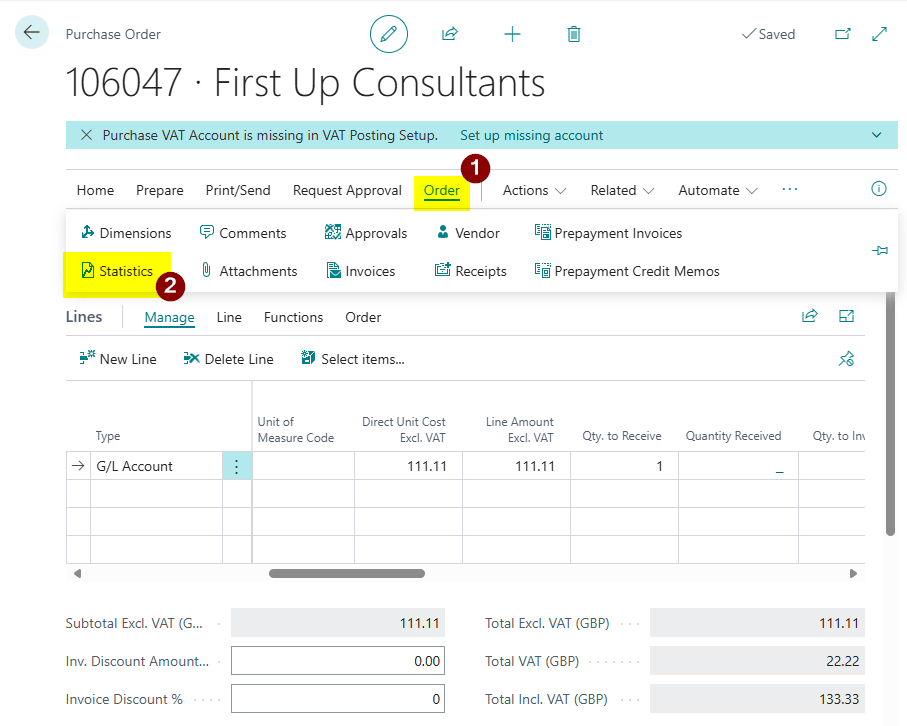
We now click “Order > Statistics”
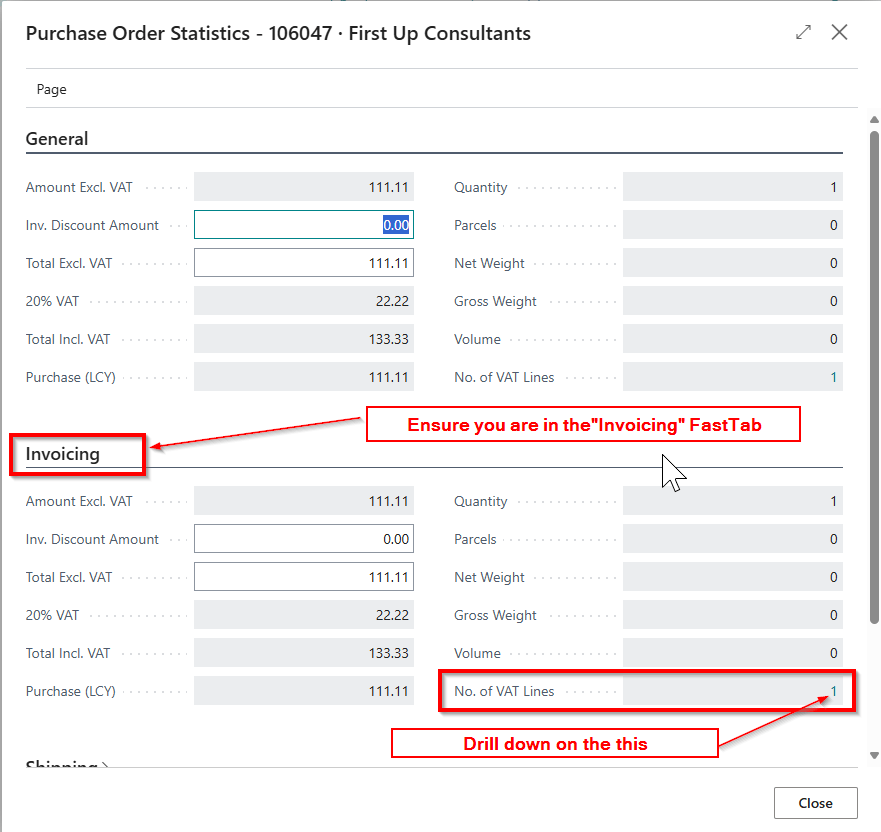
You now drill down on the “No. of VAT Lines” in the “Invoicing” FastTab
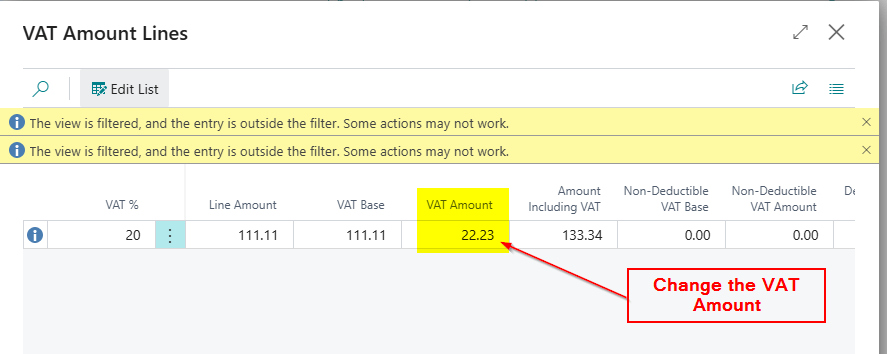
You can now edit the VAT amount
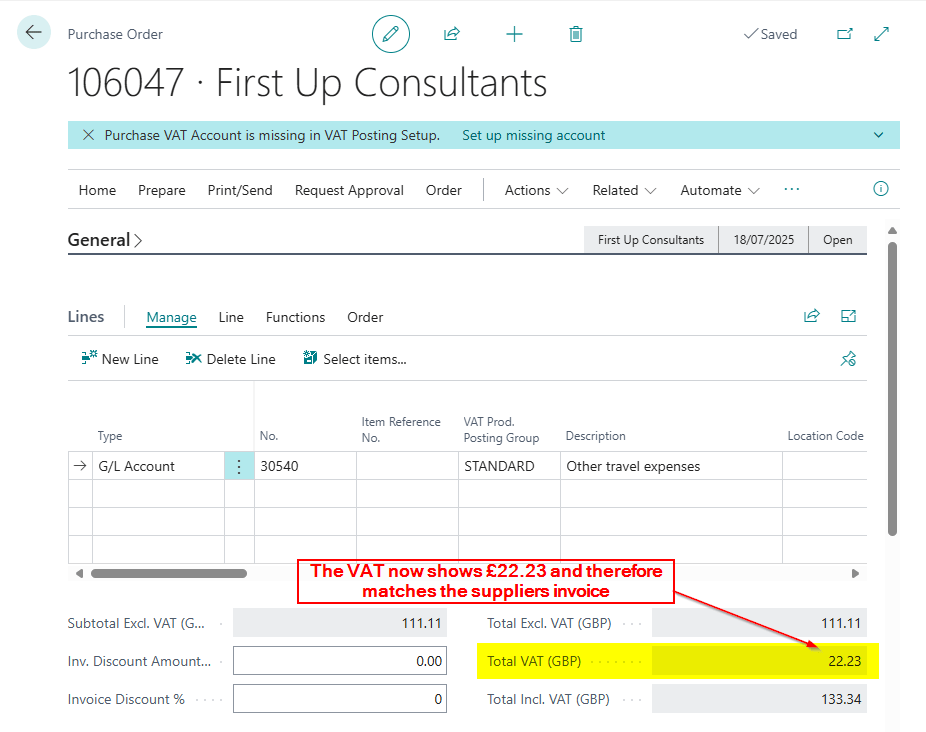
And now the VAT is reflected correctly on the Purchase Order page
Conclusion

This post has outlined how to change the VAT amount on various Purchase documents when the VAT calculated by Business Central differs from the actual supplier invoice.

Thanks for reading!
Dynamics 365 Business Central – A Method for posting VAT Opening Balances when going LIVE mid VAT Period

Introduction

In previous posts I’ve looked at how I post opening balances for various modules in Business Central. Links to these articles can be found below:

How I post opening balances for the General Ledger in Business Central

Today I wanted to discuss how I post opening balances for the VAT Statement when going live Mid VAT period.

Challenges Going LIVE mid VAT Period

If you are going LIVE with Business Central mid-VAT period, some of your VAT transactions will remain in your existing system. As a result, you won’t be able to submit your VAT return through Business Central, as it won’t include all the relevant entries. You could choose to use bridging software for submission, but you also have the option to post an opening VAT position via a journal entry.

This post will walk you through the steps to use a General Journal to record the VAT entries from your previous system enabling you to post your VAT statement from Business Central.

VAT Journal Example

To post the opening position, you’ll first need to gather the VAT figures for each box on the VAT statement from your existing system.

In this example, we’ll assume the following values have been collected from the existing system and are required for the various boxes on the VAT Statement:

VAT Box NumberAmount
Box 1 – VAT due on Sales£10,000.00
Box 4 – VAT to reclaim on Purchases£7,000.00
Box 6 – Total Value of VAT on Sales£100,000.00
Box 7 – Total Value of VAT on Purchases£70,000.00

To accommodate posting the journal we need to ensure we have a large value in the “Max VAT Difference Allowed” field in the “General Ledger Setup”

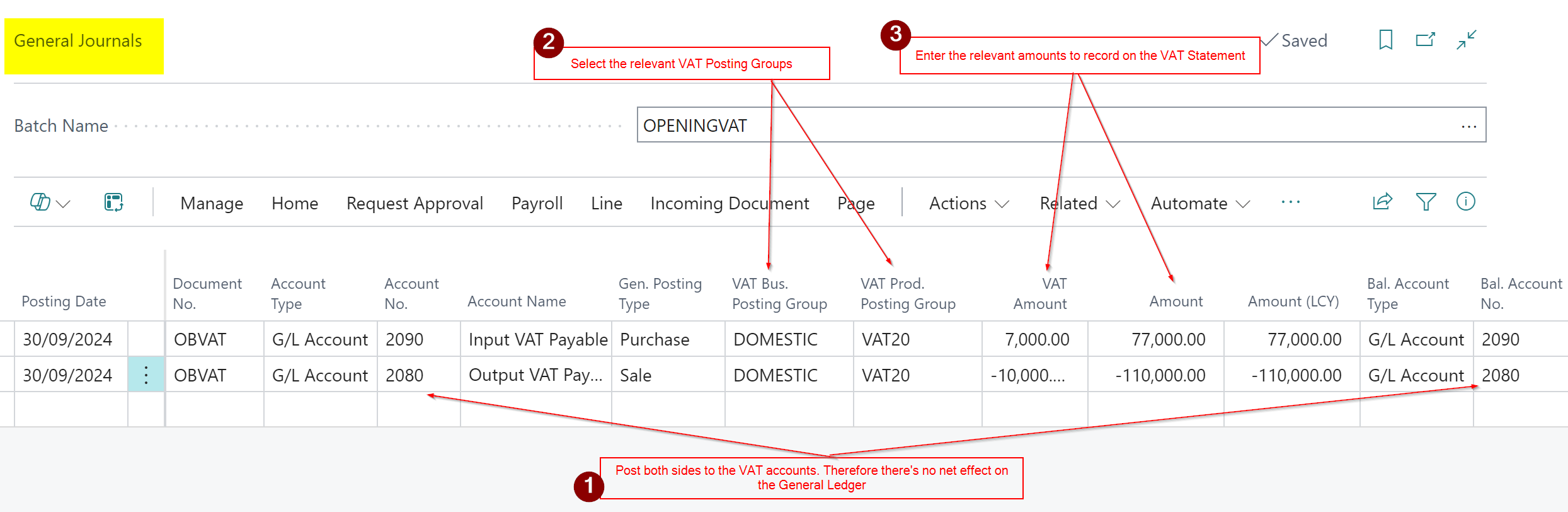
Then, to record the VAT entries we enter a General Journal as per below

Click to Enlarge

Here’s a breakdown of the General Journal:

Step 1:
Enter the VAT General Ledger codes in the “Account No.” and “Bal. Account No.” fields. This ensures the entries have no impact on the General Ledger.

Step 2:
Select the relevant VAT Posting Groups associated with the boxes on the VAT Statement.

Step 3:
Enter the VAT amounts you want reflected on the VAT Statement.

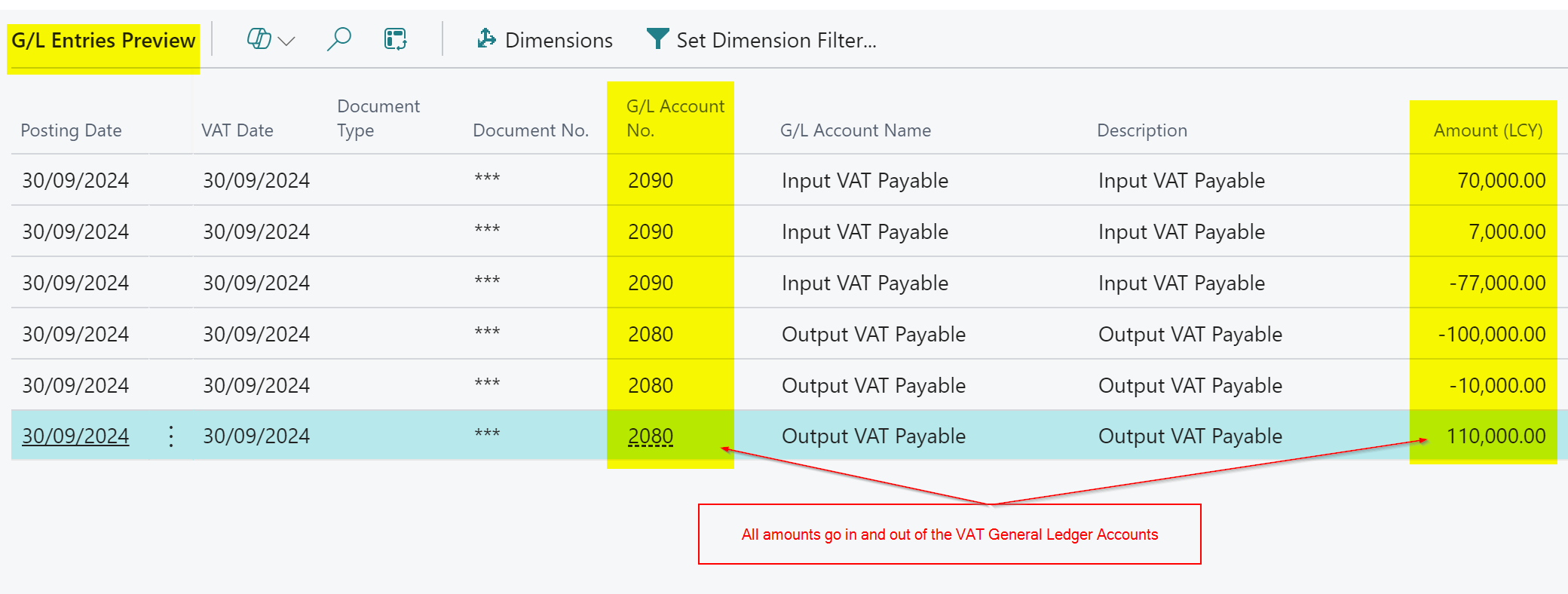
When I now preview the postings for this General Journal I can see the amounts net each other out so there’s no affect to the General Ledger.

However this journal has created the following VAT entries which can be reported on the VAT Statement.

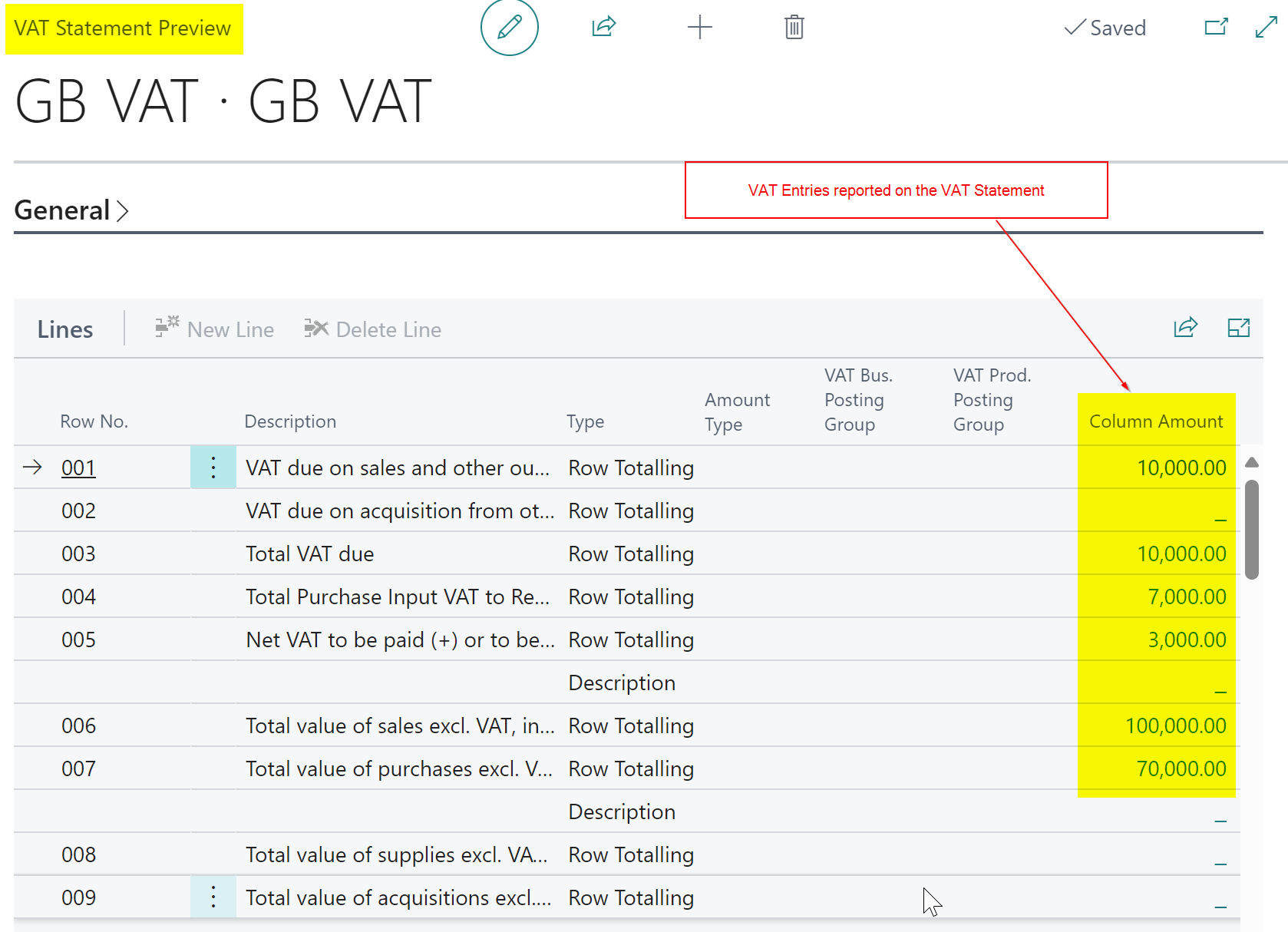
I’ll therefore post this and view the VAT Statement and I can see the amounts are being picked up correctly.

Conclusion

In the past, bridging software was commonly used when going live with Business Central mid-VAT reporting period. However, this post explains how to post a journal to record VAT entries when moving to Business Central midway through a VAT period.

Thanks for reading!

Dynamics 365 Business Central – Download a VAT Configuration package for the UK – Includes EU Reverse Charge and Postponed VAT

Introduction

If you need to post EU reverse charge purchase invoices, or you are enrolled in the Postponed VAT scheme, setting up the VAT statement can be a little more complicated than usual.

To make this process easier, I’ve created a VAT Configuration Package that contains all the necessary settings for UK businesses. This includes:

  • Standard VAT for sales and purchases within the UK
  • EU Reverse Charge for services
  • Postponed VAT on imports

What’s Included in the Configuration Package?

The VAT configuration package ensures you have the following key areas of the system pre-configured:

VAT Business Posting Groups: These are linked to your Customers and Vendors.

VAT Product Posting Groups: These are linked to your items and services, ensuring that VAT is calculated correctly based on the nature of the sale or purchase.

VAT Posting Groups: These define how VAT is calculated on sales and purchase transactions.

VAT Statement: This brings everything together and what you use as the basis to submit to HMRC.

General Journal for Testing: This includes journals you can post to test the VAT Statement is working as you’d expect.

Download the Configuration Package

You can download the configuration package using this link.

I hope this helps.

Thanks for reading!