Dynamics 365 Business Central – How to proportionally split costs across Dimensions using Statistical Accounts and Allocation Accounts

Introduction

When posting certain expenses in Business Central, you may want to split the costs proportionally over several cost centres using a specific value or metric. For example you may want to split a heating expense across the Factory and Office cost centres based on the square footage that each occupies.

In this post, I’ll show how this can be achieved by combining Statistical Accounts and Allocation Accounts to automatically distribute costs across dimensions.

Scenario

In our demo scenario we want to split the heating costs of the business automatically across our department cost centre based on the square footage they occupy.

The heating costs are recorded via the Purchase Invoice from our supplier. When keying this into the system we want to be able to simply select one Allocation account, enter a total amount of the invoice, and then the system to automatically post this to one heating GL account but split across the Department dimension.

This will seamlessly record the heating costs more accurately across the Department dimension.

This post assumes you have a dimension called “Department” already configured with the relevant values.

Statistical Account Configuration

First, we need to create a statistical account. But before that, a quick introduction to why they are useful 😊.

Statistical accounts allow you to store non-financial information such as square footage or employee count. You can then use this information in multiple ways, such as in calculations in financial reports or allocating costs.

For this scenario I’m going to create one called SQUARE FOOT and configure it as per below:
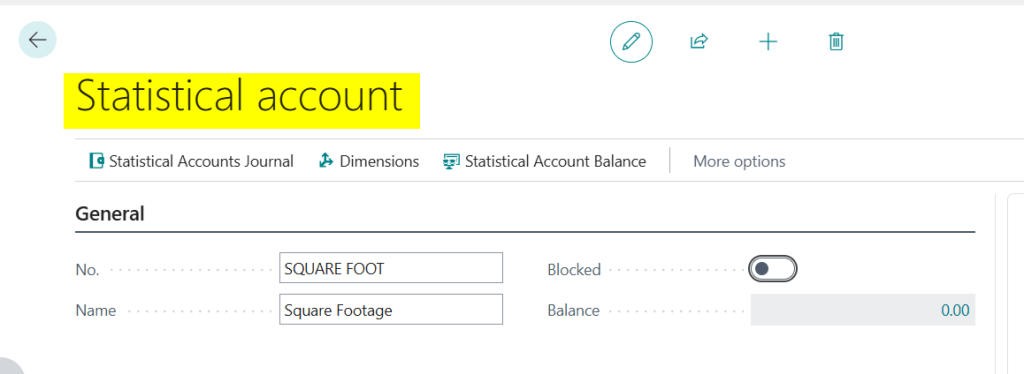
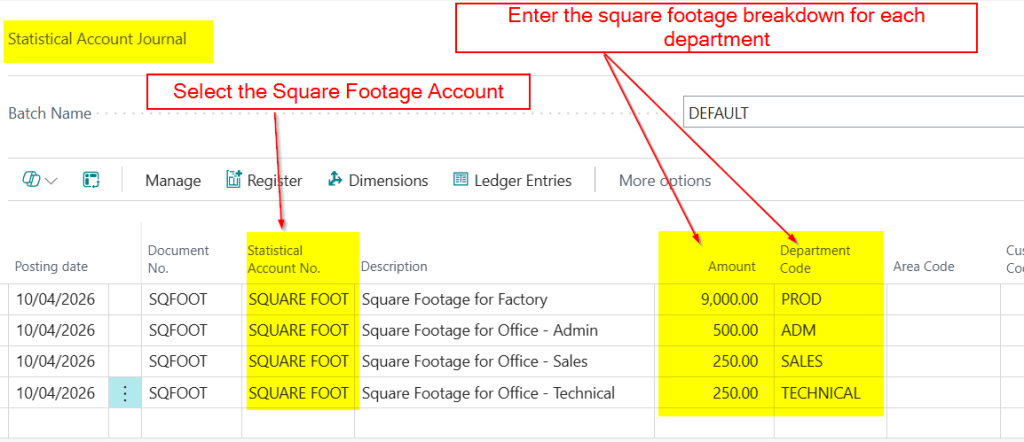
Next, I’ll click “Statistical Accounts Journal” and post the entries to record the square footage for each department.

I’ve done this as per below:
In reality, the square footage figures are unlikely to be this straightforward, but I’ve kept them simple here so the calculations are easier to follow when posting the Purchase Invoice 😊

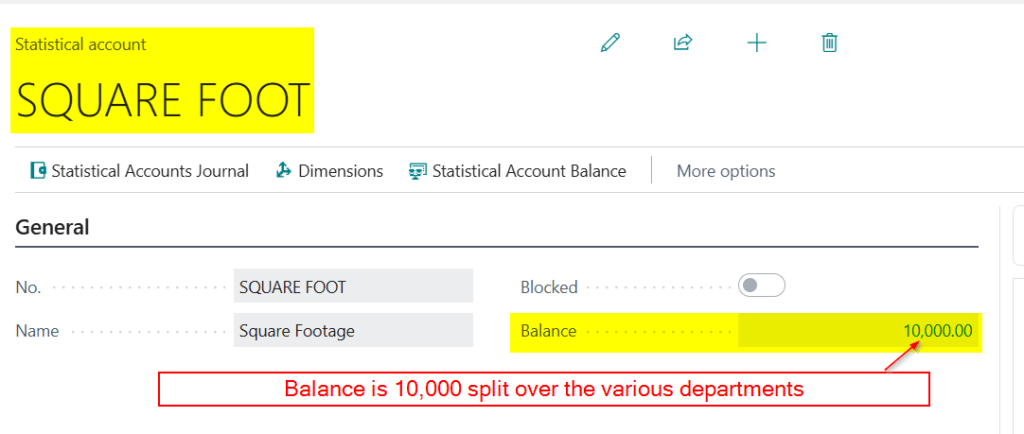
The balance on the Statistical Account is now 10000 which is split as 9000 to the PROD (Factory) department, 500 to the ADM department, 250 to the SALES department, and 250 to the TECHNICAL department.
Allocation Account Configuration

Now we have configured the Statistical Account we need to create the Allocation Account and use the Statistical Account in the breakdown 😊.

We will therefore go to “Allocation Account” page and set this up. We’ll go through in steps and explain each one as we go.

The first step is to add the “Allocation Account” and select the GL account we want to break the costs over and what the breakdown account will be.
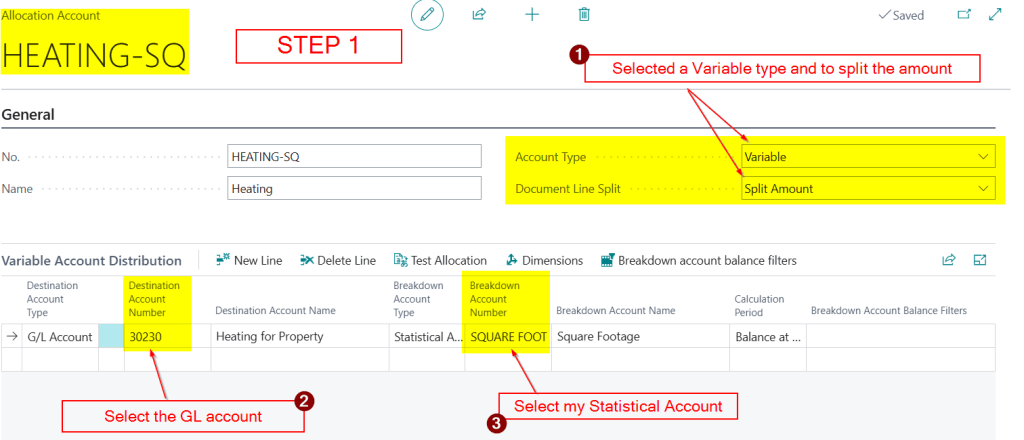
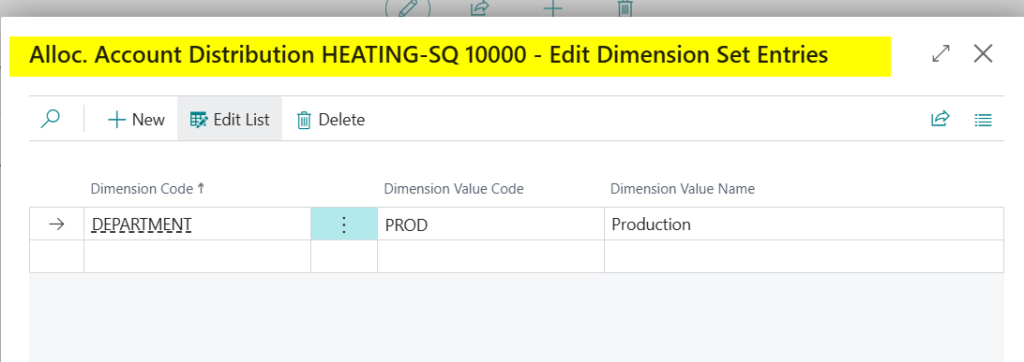
Next, while on the line, I’ll click “Dimensions” and select the Department dimension and the dimension value PROD.
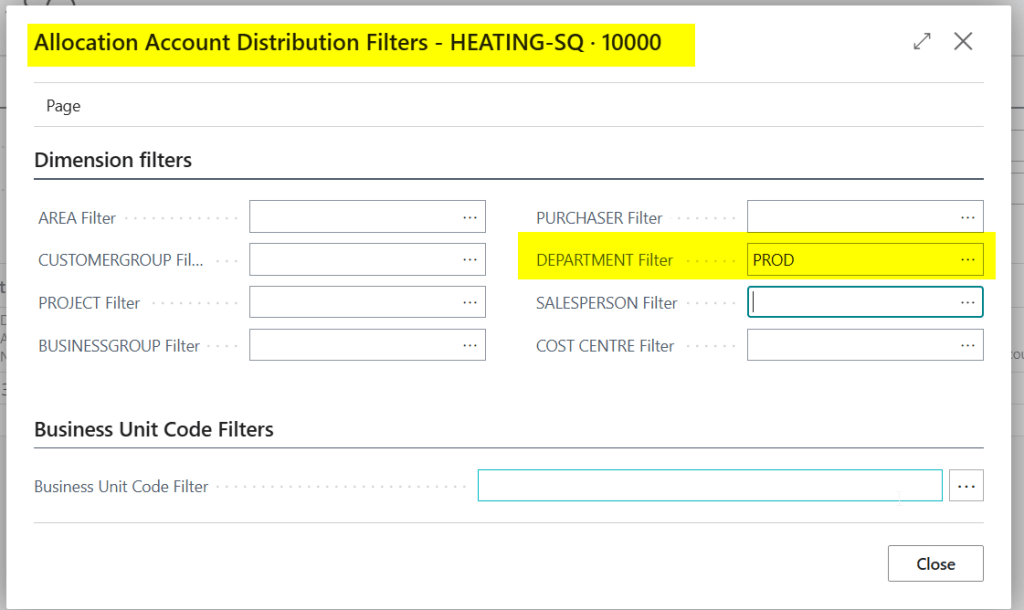
Now, back on the main Allocation Account screen I’ll click “Breakdown account balance filters” and enter the Department of PROD.
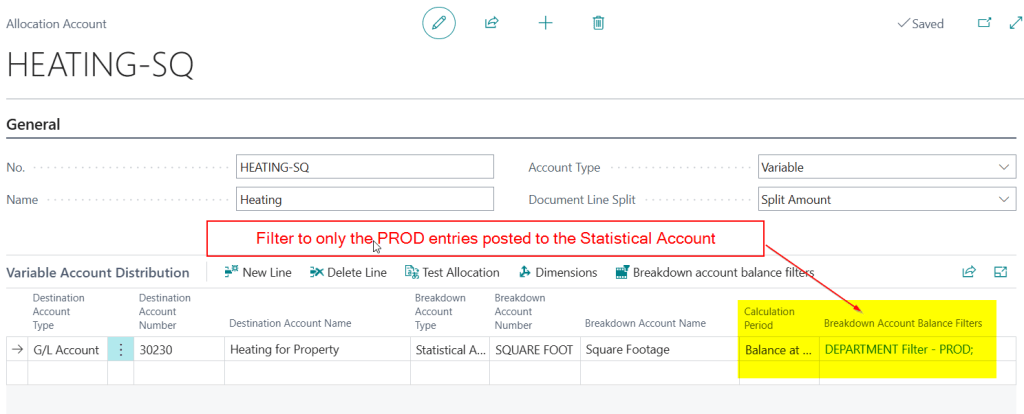
Returning back to the “Allocation Account” and you can see this line is filtered for the balances posted to the PROD dimension value.
I need to repeat this process for all the dimensions in the statistical account I want to break the costs down over.

Therefore my final configuration looks like the below.
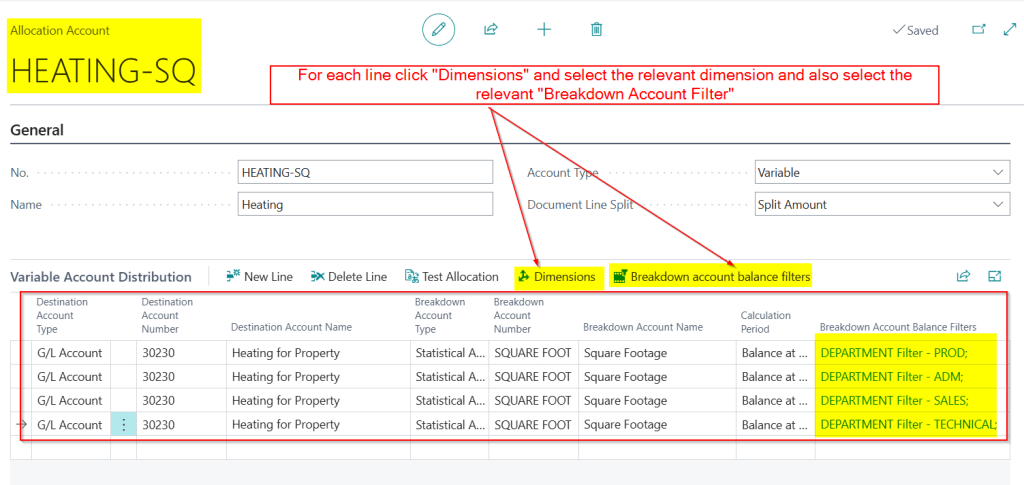
For example, on the second line I selected the ADM dimension value under “Dimensions” and then applied the same value within the breakdown account filters. On the third line, I repeated this process for the SALES dimension, and on the fourth line for TECHNICAL.

I’ve now completed the configuration 😊. Now, when I post a Purchase Invoice I should be able to select the HEATING-SQ “Allocation Account” and have the costs split across dimensions automatically based on the values in my Statistical Account.

Let’s give it a try 😊

Posting a Purchase Invoice to the Allocation Account

Now I’ve completed the configuration lets give it a try.

I now have a Purchase Invoice from my energy supplier for the total heating costs for our business premises. As discussed this includes a factory and office space.

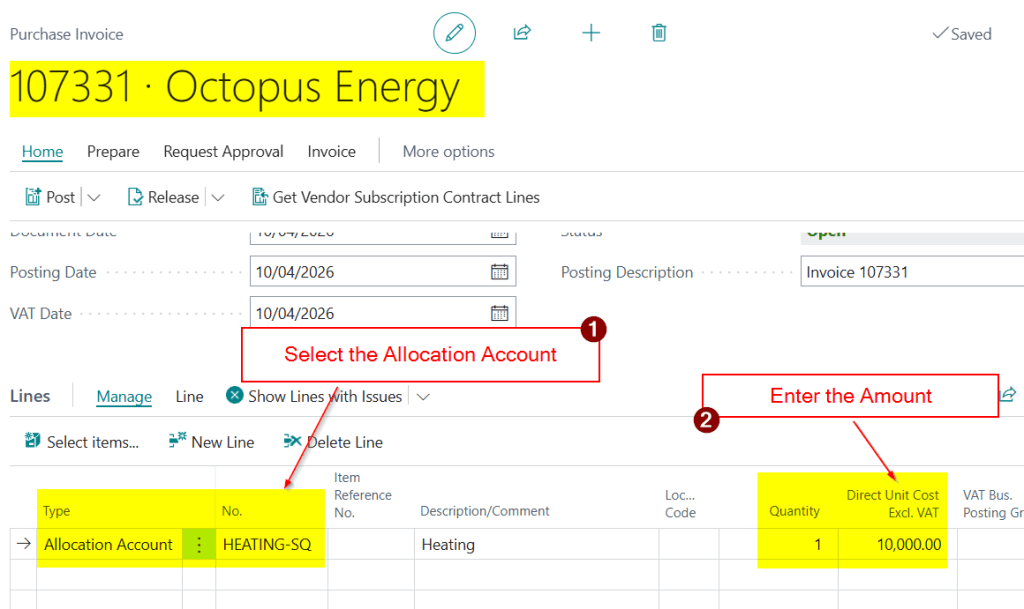
I’ll therefore create the invoice for the total cost as per below ensuring I choose the Allocation Account called HEATING-SQ.
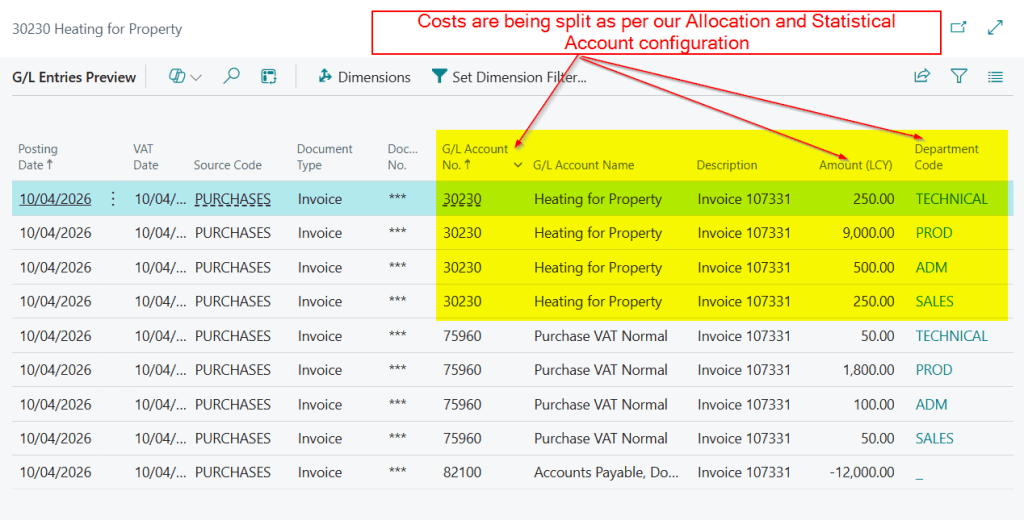
Then, when I select “Preview Posting” you can see the cost is being automatically split across the various dimensions using the statistical account
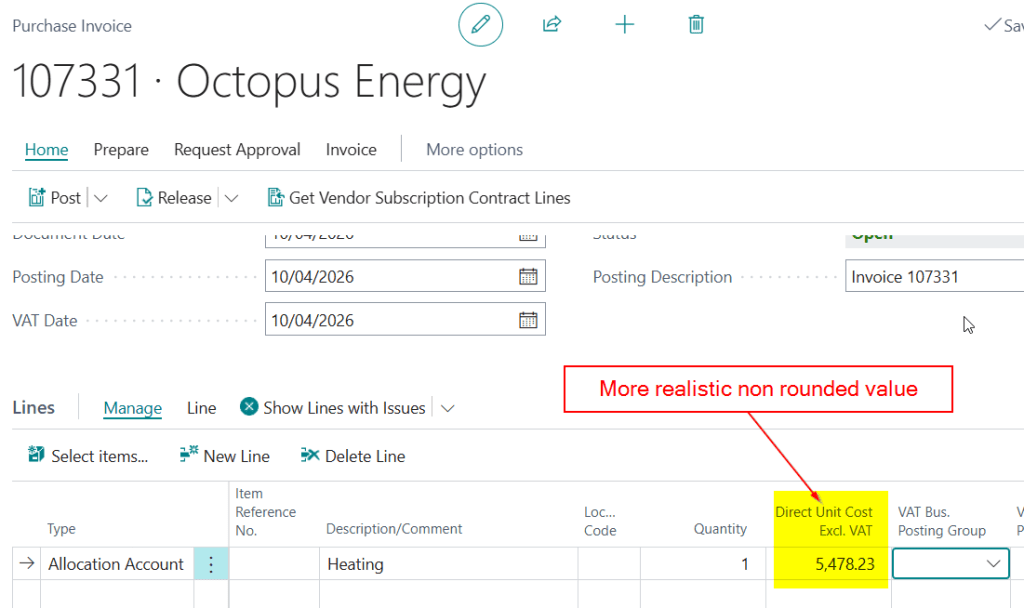
To make this more representative of a real scenario, I’ll use a non-rounded invoice value instead of 10,000.00 so you can see how the system calculates and splits the amounts more precisely across the dimensions.
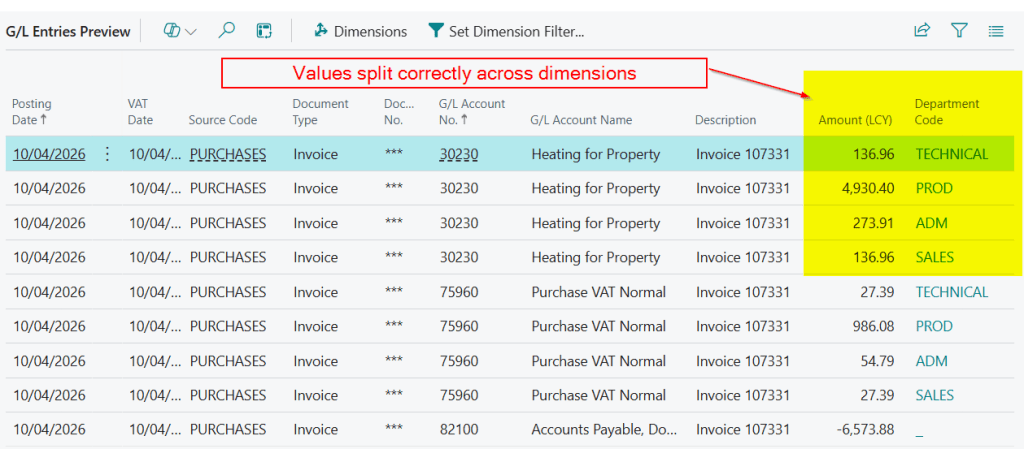
And you can see the values split nicely across the dimensions
Conclusion

This blog goes through how you can automatically split costs across dimensions based on non-financial information like square footage. It goes through how to configure a Statistical and Allocation Account to acheive this.

What’s amazing about this feature is if the office space changes or the factory is expanded, you only have to post another Statistical Journal entry reflecting the updated figures and the system will automatically use the revised values the next time allocations are run, ensuring your cost distributions always stay accurate without any need to amend your allocation setup 😊

Thanks for reading!
Dynamics 365 Business Central – Why isn’t Payment Tolerance being taken automatically in the Cash Receipt Journal?

Introduction

Sometimes customers may not pay the full amount of invoices which can leave small balances on their account. At this point we can either chase our customers to pay the balances or alternatively we can write off those small amounts.

Business Central provides functionality called “Payment Tolerance” that allows you to write off the small balances when you are applying the invoices. However in order for this to work the cash receipt must be entered and posted in a specific way, otherwise the payment tolerance won’t be taken automatically.

In this post we’ll walk through a payment tolerance scenario showing the conditions where Business Central won’t automatically take the payment tolerance

Some Setup

You can setup payment tolerances via the General Ledger Setup.

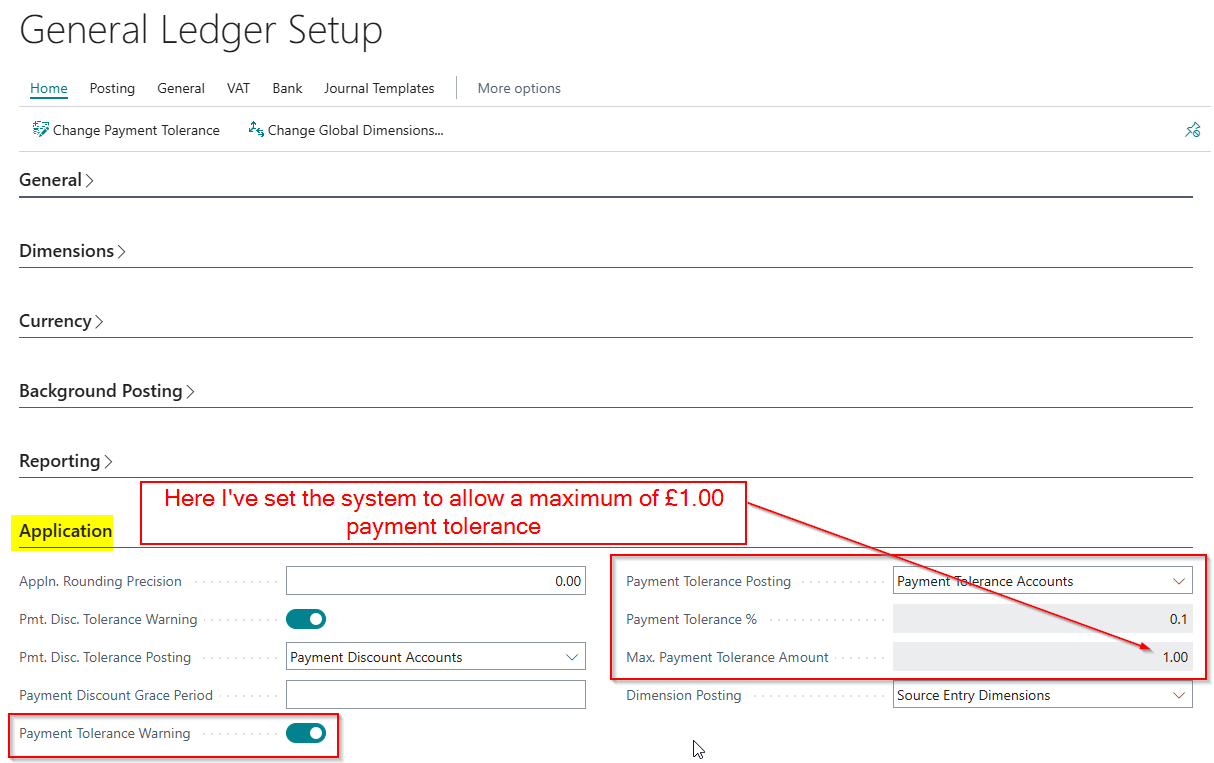
As per below I’ve set the system to allow the payment tolerance of 0.1% of the invoice value with a maximum tolerance of £1.00. Therefore if I were to post a Sales Invoice for £10,000.00 we’d still only be allowed a payment tolerance of £1.00.

Sales Invoice with Payment Tolerance

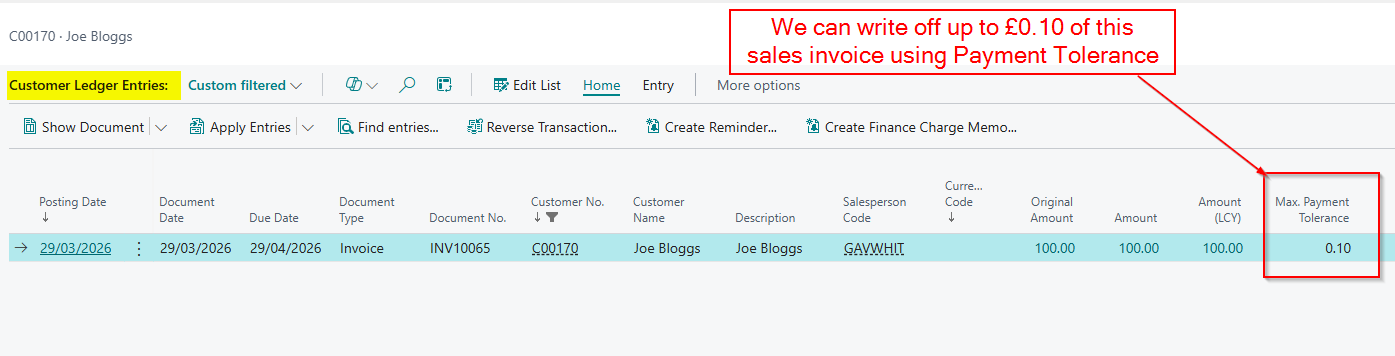
Next, I’ll post a Sales Invoice for £100.00 and as you can see this has a payment tolerance of £0.10 meaning if the customer were to pay anything up to £99.90 we can write off the difference automatically using payment tolerance.

Taking the Payment Tolerance (including the common mistake)

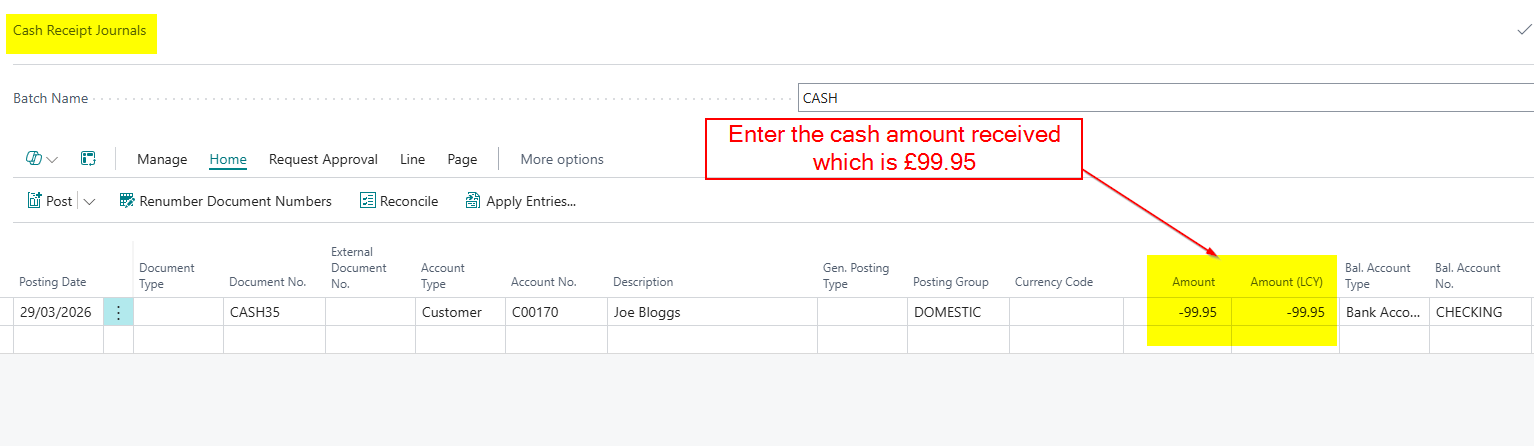
Now we receive payment from our customer however they have only paid us £99.95. As the balance is so small, we don’t want the hassle or potential harm to customer relationship, of chasing the remaining amount. Therefore we wish to automatically write off this amount.

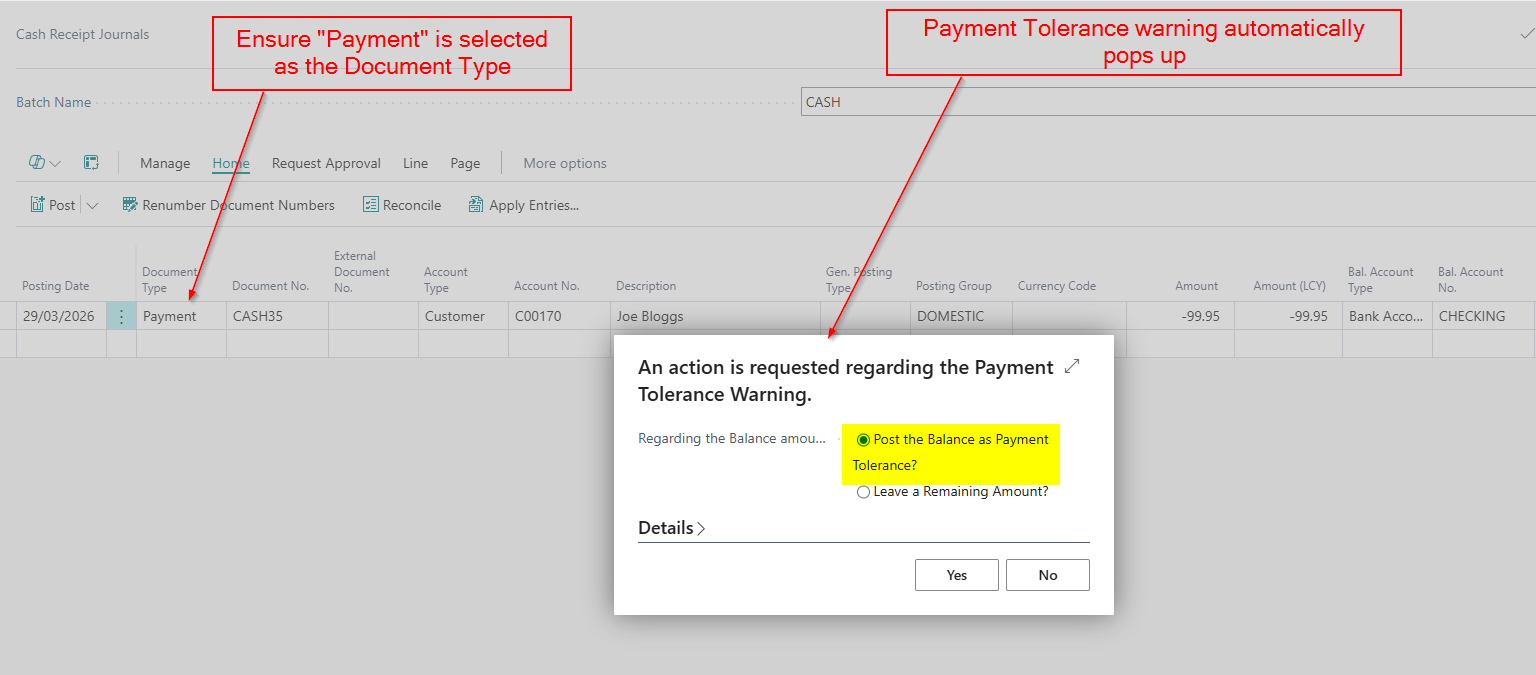
To do this I’ll go to Cash Receipt Journal and enter the payment as per below:

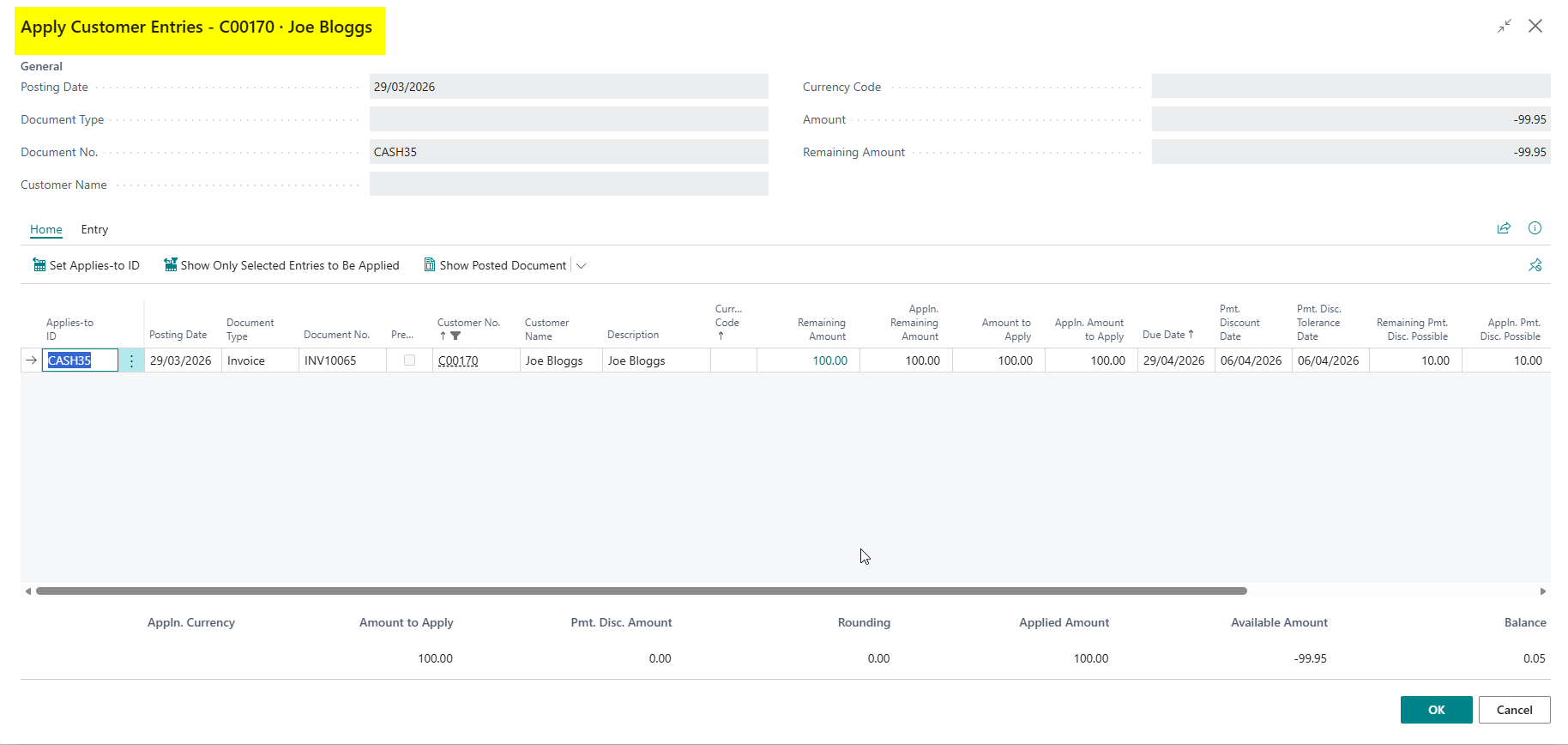
Next, we’ll apply the payment to the invoice.

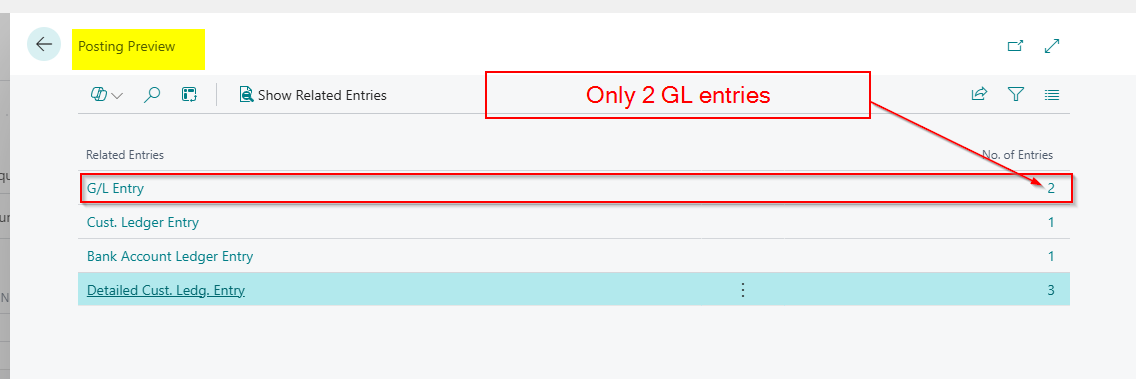
However after clicking OK, there is no payment tolerance message, and the GL entries don’t show a posting to the payment tolerance account?

We appear to have done everything correctly, so why hasn’t the payment tolerance functionality worked?

Its a very subtle issue……have you spotted it? 😊.

The issue is when I applied the cash in the first instance, I didn’t select “Payment” as my document type, and this must be selected in order for the functionality to work.

I’ll therefore delete and re-enter the cash receipt ensuring I select “Payment” as the document type and now I get the tolerance message.

I’m getting this warning because I toggled “Payment Tolerance Warning” in the General Ledger Setup. I can switch this off if I like.

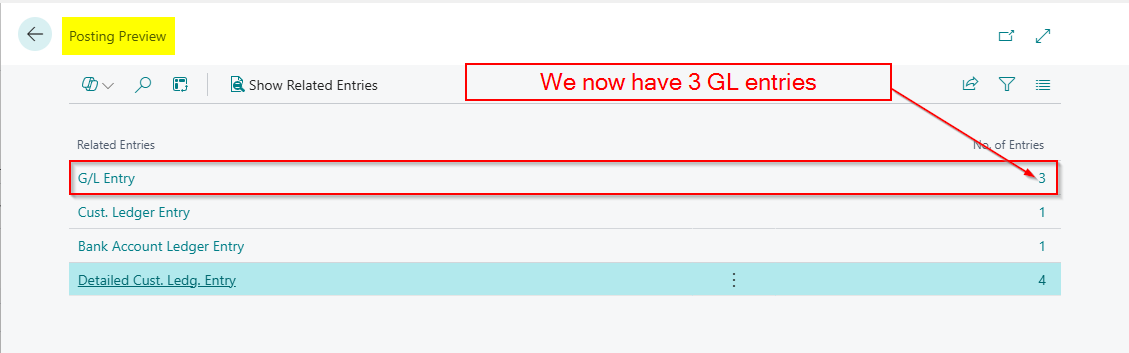
And crucially when posting the Cash Receipt I now have an extra GL entry for the payment tolerance.

Conclusion

This blog goes through the extremely useful payment tolerances functionality in Business Central.

It in particular highlights why, when you have seemingly configured payment tolerances correctly, the payment tolerance isn’t taken.

Thanks for reading!

Dynamics 365 Business Central – Handling the message “Only the Posting No. Series can be filled in on recurring journals” in Recurring Journals

Introduction

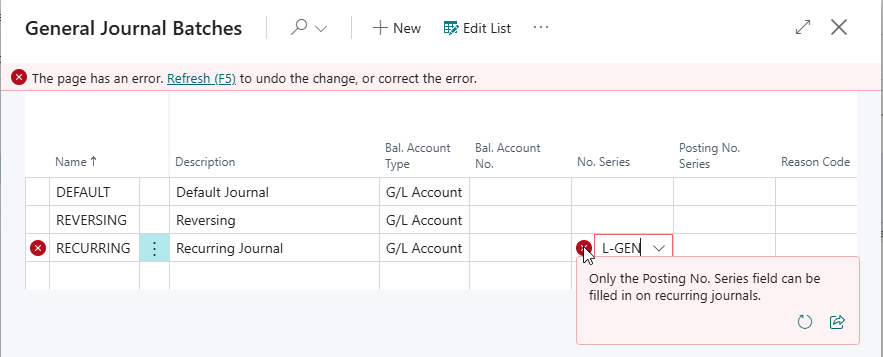
When entering a Number Series on a “Recurring General Journal” batch you receive the message “Only the Posting No. Series can be filled in on recurring journals”.

In this post we’ll take a quick look at the functionality of a Recurring General Journal, why I think the message appears, and look at two techniques you can use to ensure a unique document number is created each time the journal is posted, without the need to constantly update the document number before each posting.

A Brief Look at Recurring Journals

The Recurring Journal has unique features over and above a normal General Journal. Its designed for entries that are made regularly such as prepayments, depreciation or payroll journals etc.

The great thing about Business Central is there are many other features you can use for journals like prepayments and depreciation such as deferrals or standard journals however in this post we are focussing on recurring journals

One of the main features of the “Recurring General Journal” is that unlike a “General Journal”, after posting a Recurring General Journal the journal lines remain and the posting date is updated based on the recurring frequency. This means if don’t have to re-key the same journal every month.

However this also poses a question for what we do about the Document Number? Ideally we want to be presented with a unique document number after posting each iteration of the journal, so how can we accomplish this if this isn’t being updated?

The Error

The first thing we can try and do is use a “No. Series” on the batch, however when trying to select a “No. Series” on the “Recurring General Journal” batch you are presented with the error message below

So I guess the first question is…..why is the system preventing us from using a “No. Series” on the batch?

Although I can’t be certain, I assume its because after we post the batch the lines on the recurring journal will remain. If this is the case the number in that number series will be used over and over again (unless we change it). Therefore the system is preventing this.

So the next question is…..how can I get a unique document number on the journal line without having to update it every time its posted?

Using a “Posted No. Series” on the Journal Batch

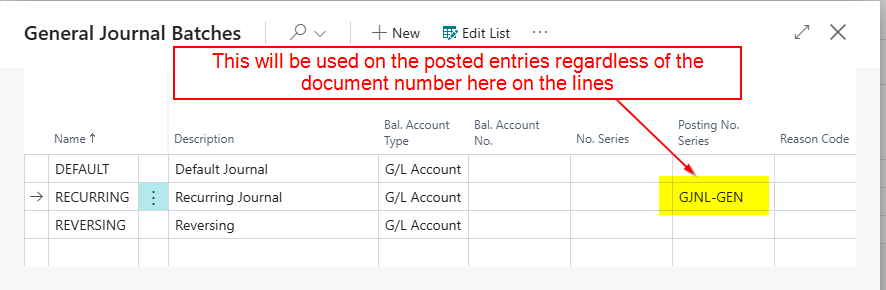
Now, its worth noting we could just enter a descriptive document number on the unposted journal lines and fill in the “Posting No. Series” on the batch header. The document number on the lines wouldn’t then be carried through to the General Ledger Entries.

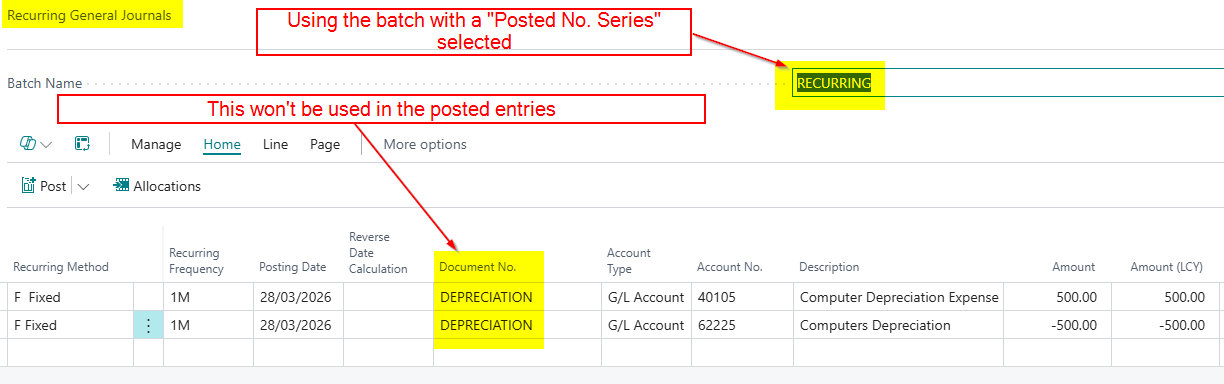
For example here I’ve populated the “Posted No. Series” on the batch header:

Now the document number I’ve entered on the lines on my Depreciation Journal below won’t be carried through to the “General Ledger Entries” when I post the batch

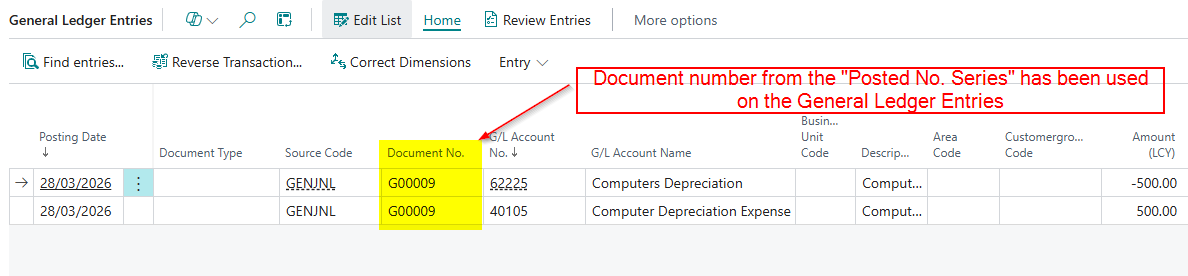
I’ve now posted the batch and you can see the document number being used has come from the “Posted No. Series” not the document number I used on the journal lines.

However, I want to use my own unique document number on the lines, but I don’t want to have to change it after each posting.

How can I achieve this?

Getting a Unique Document Number using Placeholders (Variables)

This is the final piece of the puzzle and its pretty cool 😊.

You can achieve unique document numbers by using placeholders right in the document number 😊

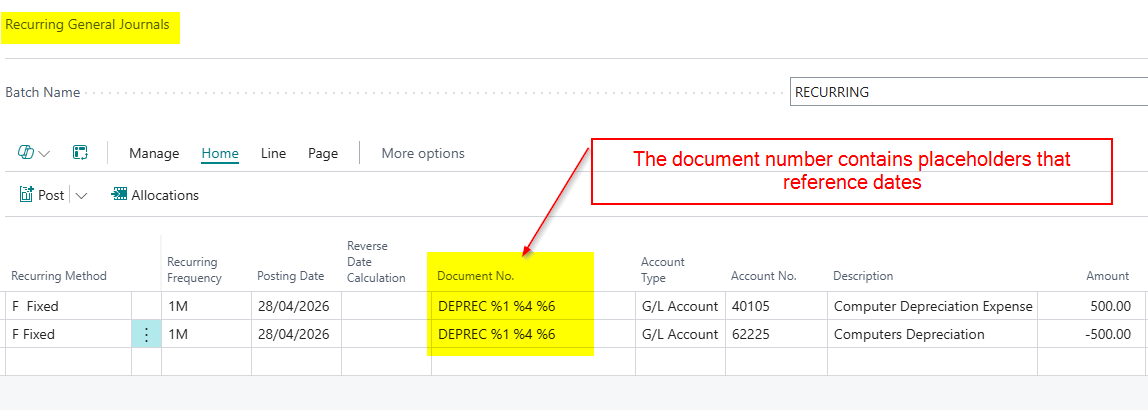
So going back to my Depreciation Journal, if I want the document number to include the date I can enter it as per below:

In the example above when I post the journal the system will replace the placeholder %1 with the Day number, %4 will be replaced with the Month name and %6 will be replaced with the year of the posting date of the journal.

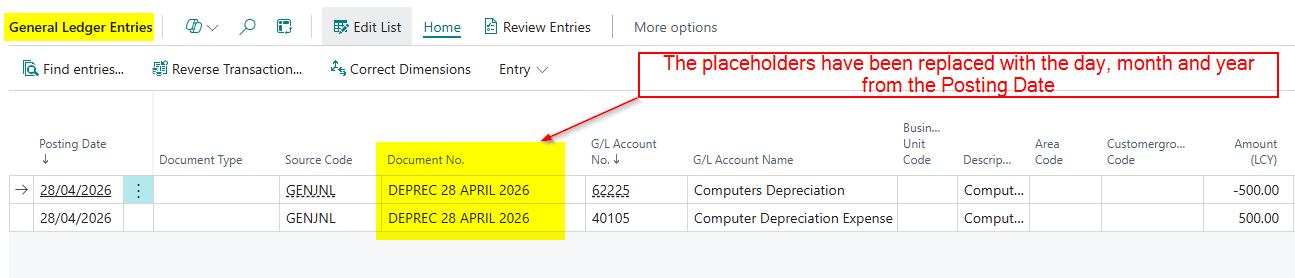
The document number is then shown as per below in the “General Ledger Entries”

When I post this for May, there’s no need to update the document number. The system automatically replaces the placeholders using the posting date in the final document number in the posted entries.

If you’re curious about what other placeholders can be used. There is a full list below:

  • %1 = The day number of the period posting date
  • %2 = The week number of the period posting date
  • %3 = The month number of the period posting date
  • %4 = The month name of the period posting date
  • %5 = The accounting period name of the period posting date
  • %6 = The fiscal year of the period posting date

If anyone has used the deferral functionality they are exactly the same and more information on them can be found here https://learn.microsoft.com/en-gb/dynamics365/business-central/finance-how-defer-revenue-expenses

Conclusion

This post highlights the issue when using “Recurring General Journal”, in that you can’t use a “No. Series” on the journal batch.

We’ve looked at why I think that restriction exists, and how you can instead use the “Posting No. Series” on the batch header to ensure your posted entries receive a unique document number each time.

Alternatively, you can use placeholders within the Document No. field to dynamically generate meaningful document numbers without having to update them after every posting, which I find particularly useful 😊

Thanks for reading!