A client reported different behaviour when accessing the “General Journal” page across their various companies in Business Central.
When searching and selecting “General Journal” in one company, it opened the “General Journal” page immediately. However, in another company, they were presented with a “General Journal Template List” page. At this point, they had to select a template, before they could being entering the journal.
In this post, I’ll show why the companies are exhibiting different behaviour when trying to do the same task.
The Pop Up
In one company, when searching and selecting “General Journal” they are presented with the “General Journal Template List” page below:
This differs from the other company, which immediately takes them into the “General Journal” page so they can begin entering journals.
More on General Journal Templates
The clue for why this is happening lies in the heading of page that pops up – “General Journal Template List”.
Although we don’t have much interaction with General Journal Templates, one exists for each type of Journal that you can create (i.e. Payment Journal, Cash Receipt Journal, General Journal etc), providing default information for all their journal batches.
For example, a General Journal Template exists for journals that are entered via the “Payment Journals” page, one exists for journals that are entered via the “Cash Receipts Journals”, one exists for Journals entered via the “General Journal” page and so on.
The batches into which journals are entered are specific to the General Journal Template. Incidentally, this explains why a batch created in a “General Journal” page isn’t visible in the “Payment Journals” page, and vice versa.
The Issue
As the pop up is asking us to select a “General Journal Template”, the answer to the issue must lie in how these are configured.
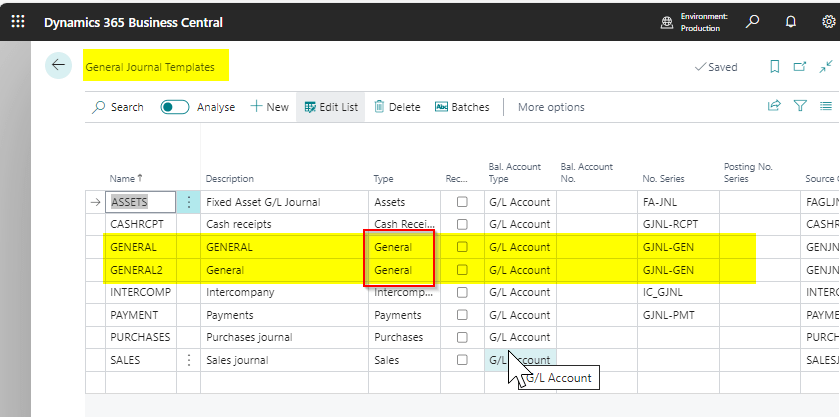
I therefore open the “General Journal Template” page and spotted someone had created an additional template of Type “General”.
After a little digging, it appears a new user had mistakenly created the “GENERAL2” template when trying to create a new batch.
To resolve the issue I simply deleted the duplicate General Journal Template and the pop up has now disappeared.
Conclusion
While it’s technically possible to have multiple General Journal Templates for each Type, it’s not typically considered standard practice.
Rather than creating multiple General Journal Templates, its generally recommended to create multiple batches within each Template.
This blog was inspired by a forum post I answered recently that you can find here. The OP had issues reconciling their bank accounts because the opening balance hadn’t been posted. It also follows on nicely from other blogs I’ve posted with regards to posting opening balances. These are below:
In this blog I’ll show the steps I use when posting opening balances for bank accounts.
Preparation
When going LIVE with Business Central I always recommend reconciling all the outstanding bank entries in the source system. This is much easier nowadays as most payments are made electronically. Therefore there tends to be less “Unpresented Cheques” delayed by either the postal service or waiting to be deposited in the bank. This includes cash received from customers or payments made to suppliers.
If everything has been reconciled, it makes posting the opening balance much easier and cleaner.
Method for Posting the Opening Balance
When going LIVE with Business Central, I’ll usually have been provided with an opening trial balance, which includes the reconciled bank account balance which has been posted to the GL. I’ll use this as the basis of the bank account opening balance journal.
Its worth noting you could post the bank account opening balance at the same time as the GL opening trial balance, however I prefer keeping the two entries separate. Also, there are situations where an opening trial balance might not be available, whereas the opening bank position has been provided. (in the forum post the client had gone LIVE without a bank opening position, and this method can also be used to post a retrospective bank opening position)
For the bank account opening balance, I then need to post an entry that posts a Debit and Credit to the same Bank account GL code, but also creates a Bank Account Ledger Entry.
Worked Example
In this example I have a bank account that has an opening balance of £1000.00, which has already been posted to the GL. Therefore the GL code has a balance of £1000.00, however the Bank Account has a £0.00 balance.
As the GL has the correct balance, I need to post an entry that only updates the Bank Account Balance.
As mentioned above, to do this I’ll create a journal that debits and credits the 40050 code, but also creates a Bank Account Ledger Entry I can reconcile.
Therefore I’ll post the journal below, that posts to the Bank Account and balances to the Bank Account GL code
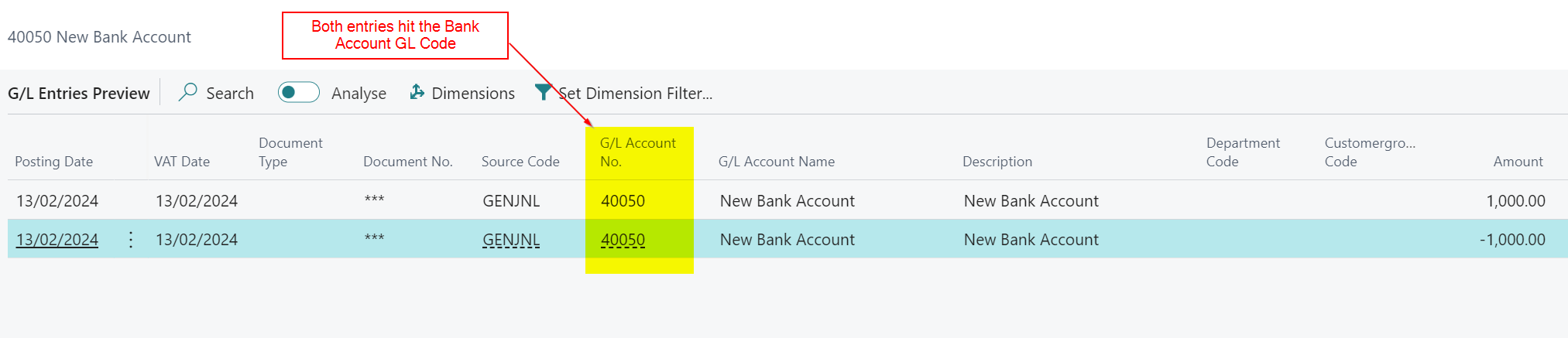
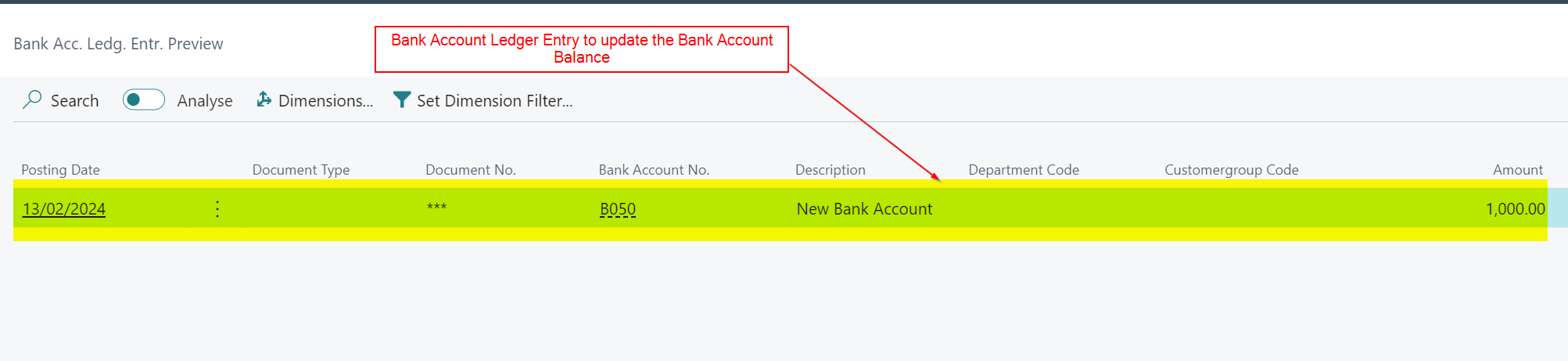
This creates GL entries that both debit and credit the Bank Account GL code but also a Bank Account Ledger Entry that hits the Bank Account
After posting this I have a Bank Account Balance that matches the GL balance
Conclusion
This is a quick and easy method for posting opening balance entries to Bank Accounts. This can be done either during or after you receive the General Ledger opening balances.
I hope this helps when posting your opening balances or retrospectively fixing any issues with the bank account.
Thanks for reading!
Want further help with Business Central?
If you’d like more help with Business Central, I also run Rapid365, which provides Business Central implementation and support services for UK businesses, supporting you through setup and go-live.
If your business is partially exempt for VAT, you’ll need a method for tracking your VAT entries, so you can post adjusting entries to the VAT return.
In this post I’ll go through the basics of what being partially exempt from VAT means, and how you can configure Business Central to accommodate this using standard features.
** Please note there are specific non-recoverable VAT features in Business Central which I don’t cover in this post however those features compliment this configuration rather than replace it.
Normal VAT
Normally, a business would supply goods or services and charge VAT (output VAT) and also buy goods or services and pay VAT (input VAT). Then, at the end of the VAT period, the business calculates whether they need to pay HMRC (i.e. the output VAT is more than the input VAT) or reclaim VAT from HMRC (i.e. their input VAT is more than their Output VAT).
This is easily setup using standard Business Central VAT Product Posting Groups as per below:
What is Partial Exemption for VAT
The above description of Normal VAT assumes all supplies the business makes are subject to VAT (i.e. all supplies the business makes are taxable at 20%, 5%, 0% VAT). These rules don’t apply when a business makes both taxable and exempt supplies. When a business makes exempt supplies, they can’t reclaim all the input VAT on all their expenses.
The rules for claiming input VAT when you make exempt supplies and taxable supplies are as follows:
Input VAT Type
Rule
Input VAT that relates directly to exempt supplies
None of the Input VAT can be reclaimed
Input VAT that relates directly to taxable supplies
All of the VAT can be reclaimed.
Input VAT that can’t be directly attributed to exempt or taxable supplies
A portion of the VAT can be reclaimed.
With regards the final point, this relates to expenses like accountancy fees or rent. Basically any expenditure that is incurred for the business to operate. The business can only reclaim a portion of the incurred VAT for these expenses, with the amount that can be recovered being calculated based on the exempt and taxable supplies during the specified period. (worked out as a percentage)
Business Central Configuration
Now we know the basic rules around partial exemption, it becomes clear that if we qualify as partially exempt for VAT, we need a way of easily identifying whether our expenses relate to exempt supplies, taxable supplies, or are general business expenses when entering them in Business Central. (basically where they sit according to the table above)
Therefore, the first step is to add more VAT Product Posting Groups to our configuration.
We then need to add the the new VAT Product Posting Groups into the “VAT Posting Setup” as per below (note the new VAT Product Posting Groups still calculate VAT at 20%. This doesn’t change, only the amount of VAT we can reclaim is affected).
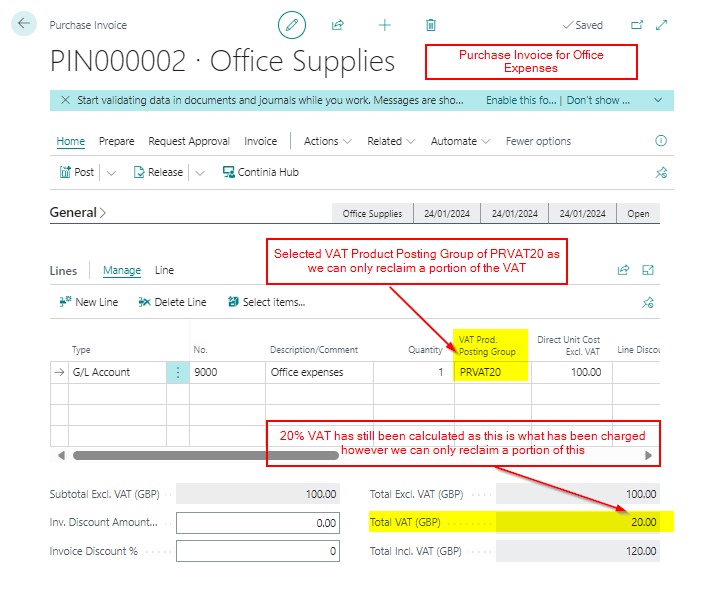
Using this new configuration, when entering a Purchase expense, and we can recover all the VAT, we should use the “VAT20” VAT Product Posting Group. When entering a Purchase expense, and none of the VAT can be recovered, we can use “PNVAT20” and when we can partially recover some VAT we should use “PRVAT20“.
Therefore, if we had a Purchase Invoice for Office Expenses, which we know we can only reclaim a portion of the VAT back, we’d use the PRVAT20 VAT Product Posting Groups as per below. This would then be easily identified in the VAT Entries.
VAT Entries – Example
Now suppose we have entered transactions to the different VAT Product Posting Groups to get VAT entries as per below:
As we have posted our purchase expenses using the correct VAT Product Posting Groups we can easily identify the following:
We have £60.19 posted to PNVAT20. We can’t reclaim any of this VAT.
We have £45.86 posted to PRVAT20. We can reclaim a portion of this VAT.
We have £88.85 posted to VAT20. We can reclaim all of this VAT.
VAT Adjustment
Let’s say we have reached the end of the VAT period, and the transactions shown above are the only transactions we have posted.
We have also performed our partial exemption calculation, and we can only reclaim 10% of the VAT posted to the PRVAT20 VAT Product Posting Group.
This means of the £45.86 posted to PRVAT20 we can’t reclaim £41.27. (90% we can’t reclaim)
We also can’t reclaim any of the £60.19 VAT posted to the PNVAT20 VAT Product Posting Group.
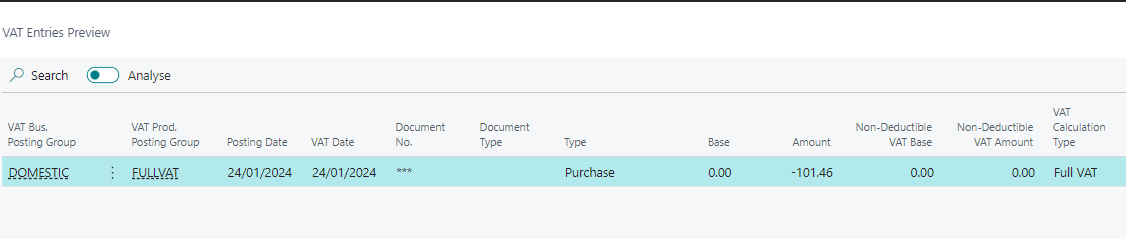
Therefore, we’ll need a combined adjustment of £101.46 to the VAT account, which we can offset against an irrecoverable VAT expense account. Therefore we would post a General Journal as per below:
When posting this journal we should also use the FULLVAT VAT Product Posting Group so we have a VAT entry that will be picked up the VAT Statement reducing the amount we can reclaim. (an adjustment to the VAT statement configuration may be needed for this if the FULLVAT Vat Product Posting Group isn’t on the VAT statement)
Conclusion
This is one method you can use for partial exemption in Business Central. It involves creating different VAT Product Posting Groups to post your purchase expenses against depending on whether the VAT will be fully recoverable, partially recoverable, or unrecoverable.
Its worth noting that Business Central does have additional irrecoverable VAT features that I’ve haven’t covered in this post. This includes a change to the VAT Posting Setup window giving you the ability to automatically post a portion of the VAT to an irrecoverable VAT GL code. I might do another post on that in the future 🙂







 thedynamicsexplorer.com