Dynamics 365 Business Central – A closer look at the Net Change, Balance at Date and Balance FlowFields on the Chart of Accounts page

Introduction

The chart of accounts page is one of the most frequently used pages in Business Central. It can provide a wealth of information, offering unique insights into the balances on GL accounts, at the click of a button.

When showing new users the Chart of Accounts page in Business Central, I always go through how the Net Change, Balance at Date and Balance columns work and what information they provide.

In this post, I will delve into the details of each column, highlighting their significance and how they work.

Add the Balance at Date Column

By default the Chart of Accounts page only displays the “Net Change” and “Balance” columns. Therefore the first thing to do is to personalise the page and add the “Balance at Date”.

You can do this in the usual way as per below:

FlowFields and FlowFilters

Providing some context, the “Net Change,” “Balance at Date,” and “Balance” columns featured on the Chart of Accounts page are referred to as FlowFields. This means they are calculated fields, and the values they display are influenced by any FlowFilters that are added to the page. In this case the FlowFilter is any filter added to the “Filter totals by” option on the filter pane as shown below
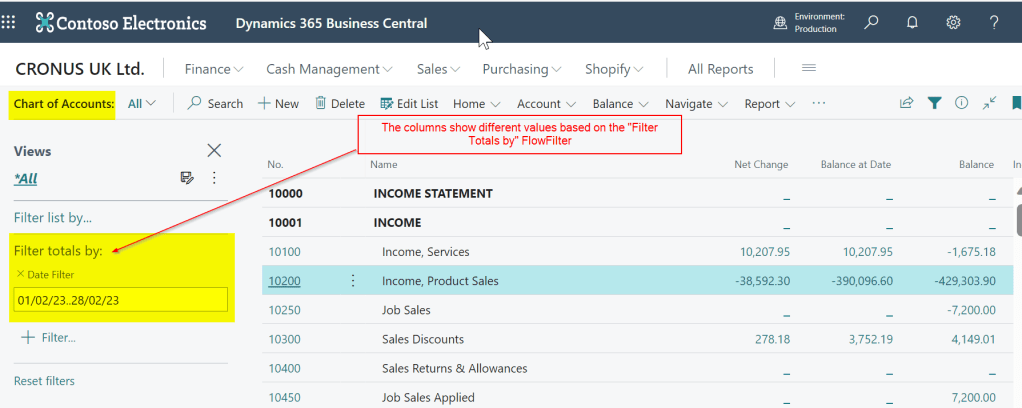
Here I’ve added a date filter which will directly affect the values displayed in the “Net Change”, “Balance at Date” and “Balance” columns.

Lets see them in action

To describe how each column works I’ve posted the following transactions in January, February and March, each for £100.00
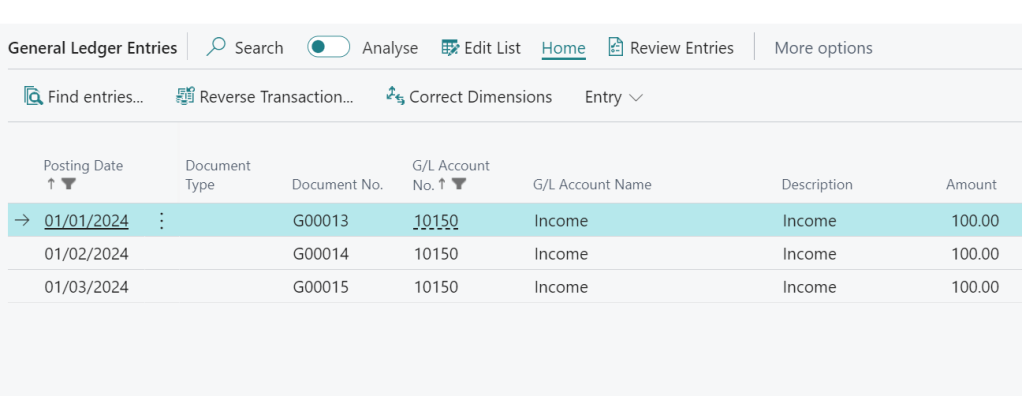
Without any filter, all columns will show £300.00, however I’ll then add a filter for February in the “Filter totals by” as per below
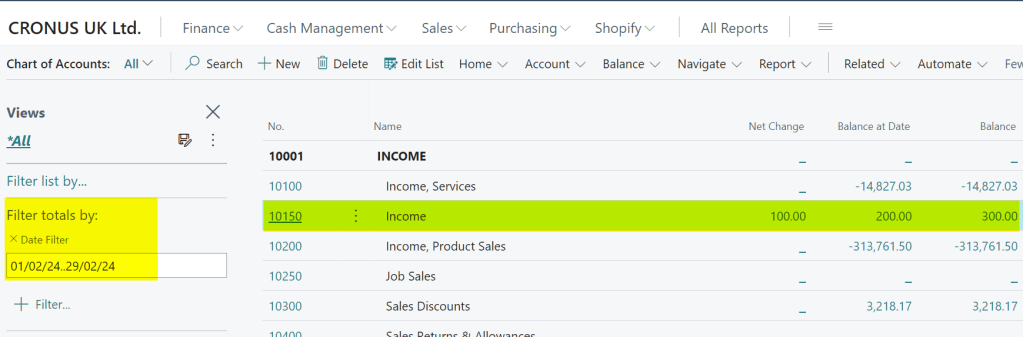
As you can see each column now has a different value, so let’s go through what each is showing:

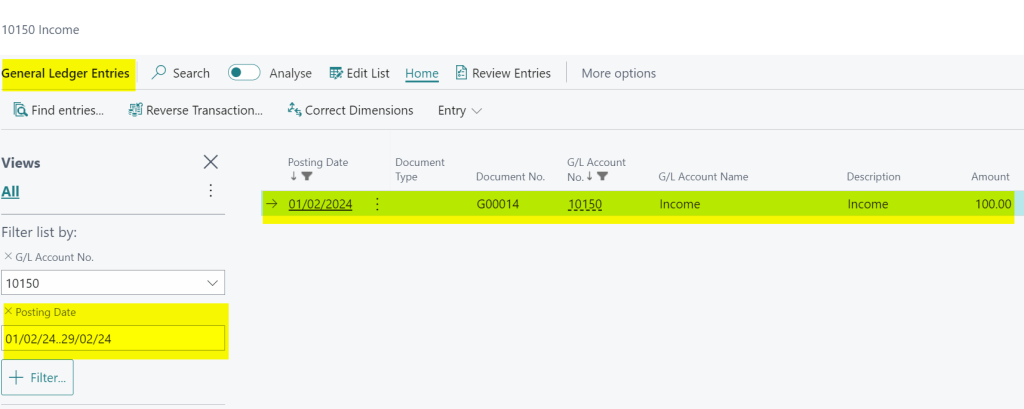
Net Change:- This is only totalling the transactions posted within the filter. In this case we have a filter of 01/02/24..29/02/24 and we have one transaction for £100.00 posted in this range, therefore the value shown is £100.00. If I drill down on this value the system opens the “General Ledger Entries” page with this filter applied showing the entry:
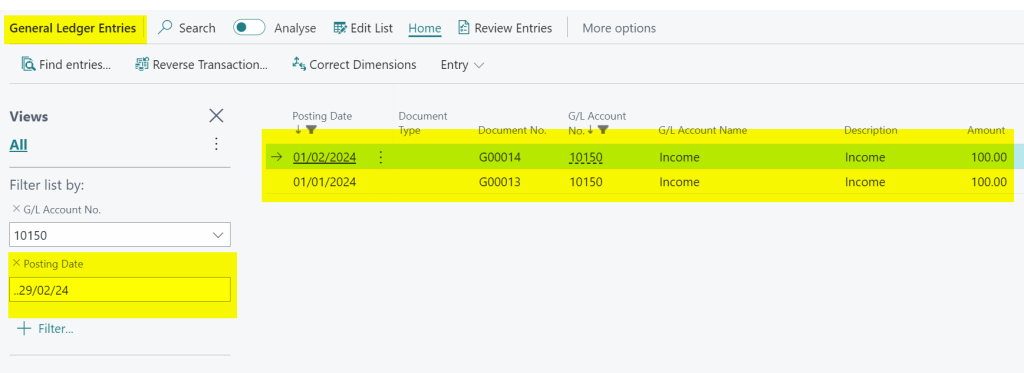
Balance at Date:- This is totalling the balance at the end of the filter. In this case the end of the filter is 29/02/24 and I have two transactions that match this criteria, one in January and one in February, both for £100.00. Therefore the balance shows £200.00. Again, if I drill down on this value the system opens the “General Ledger Entries” page with this filter automatically applied showing the entries that make up the balance:
Balance:- This disregards the filter and shows the total of the account regardless of the filter. In this case the balance shows £300.00, as I have three entries totalling £300.00. Once again, if I drill down on this value the system opens the “General Ledger Entries” page, but this time with no date filter applied:
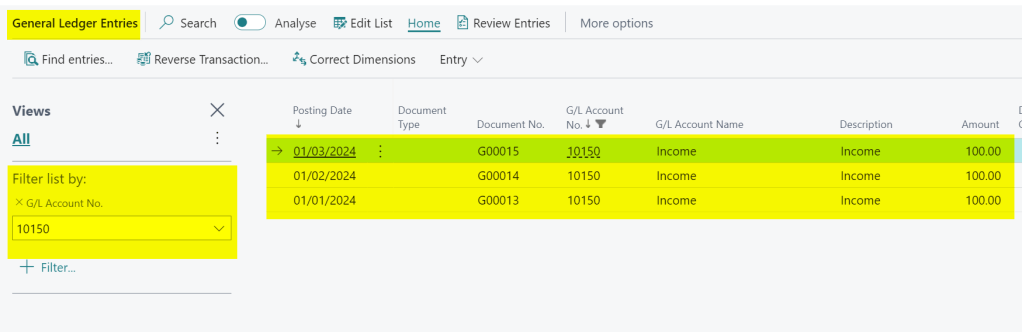
Hopefully this demonstrates how each of the columns work and how when you drill down on the values the system automatically applies filters to the “General Ledger Entries” page showing the detail of the calculation.

How about filtering by Dimension

In this example you can see how the values are being influenced by a FlowFilter entered using the posting date, giving useful insights into the balances of your GL accounts over different periods of time.

However, what might be even more interesting is rather than using date, you could use your Global Dimensions, which are also available as FlowFilters. (this is why its important to choose the correct Global Dimensions when configuring Business Central, as I explain in this video series)

In my demo system I have “Department” and “Customergroup” as Global Dimensions so I could apply a FlowFilter on one of my Departments to filter the values for just one department. For example below I add a filter on the Department SALES to filter values that have been posted to the SALES dimension.

Here, at the click of a button, I can real time insights into values posted to the SALES dimension.

Conclusion

The chart of accounts page perfectly showcases the FlowFilters and Flowfields highlighting how you can get insights into data very quickly and easily.

These filters are available throughout Business Central on pages like Customers and Vendors, granting users immediate access to essential data without the need for complex reports.

Thanks for reading!
Dynamics 365 Business Central – How to manually reconcile the Bank Account without a Bank Statement in the Bank Reconciliation page

Introduction

This post was inspired by a forum question I responded to a few weeks ago. You can find the community thread here.

In the thread the poster was looking for a way to manually reconcile the bank account in Business Central without importing a Bank Statement. They mentioned how they could do this in Dynamics GP and wanted to know if similar functionality existed in Business Central.

In this post I’ll go through how this is possible using the “Suggest Lines” functionality in the Bank Reconciliation page.

Bank Reconciliation

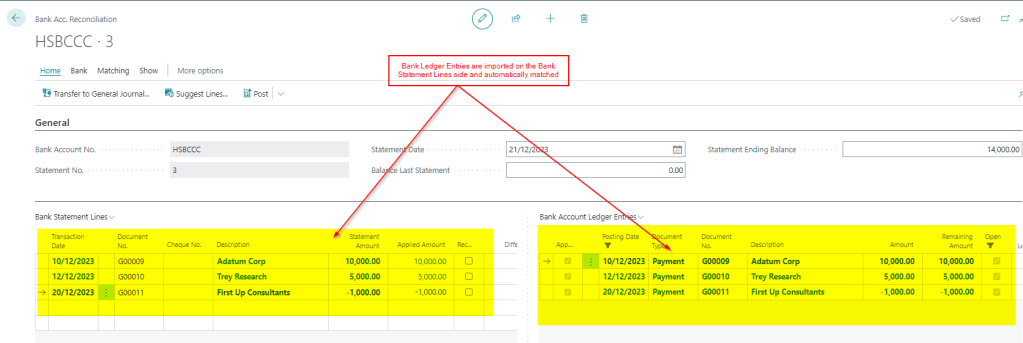
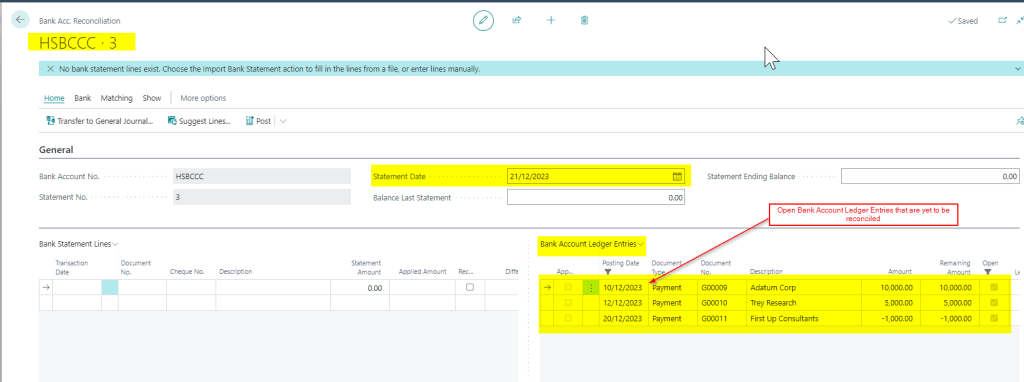
When you open the Bank Reconciliation page in Business Central, and enter a Bank Account No. and Statement Date, the unreconciled Bank Account Ledger Entries are automatically pulled into the page on the right hand pane, ready to reconcile. See below:

You can then either import the bank statement to populate the left hand pane, or manually key in each entry on your bank statement into the left hand pane. Once this has been done you can reconcile the items in each pane.

However, if you don’t want to import your Bank Statement, or the import Bank Statement functionality hasn’t been configured, how do you manually reconcile these Bank Account Ledger Entries?

Suggest Lines

In order to manually reconcile the Bank Account Ledger entries you can use the “Suggest Lines” function on the ribbon as shown below:

This will open the dialog below which you can complete with the relevant dates

When you click OK the Bank Statement Lines pane is populated with the Bank Account Ledger Entries and automatically matched.

If necessary you can then remove any lines you don’t want to reconcile and when you’re happy click post to reconcile the bank and close the Bank Account Ledger Entries.

Conclusion

If you don’t want to import a bank statement but still wish to reconcile your bank accounts this is quick and easy solution to manually reconcile your bank.

Thanks for reading!

Dynamics 365 Business Central – How to cancel a full month of Depreciation in the Fixed Assets module

Introduction

I recently encountered an issue where the fixed assets depreciation had been ran incorrectly and therefore it all had to be cancelled.

In this post, I’ll show a couple of ways you can cancel all depreciation in a given time frame or filter. These include using the “Cancel Entries” on the “FA Ledger Entries” page, and my preferred option, the “Cancel FA Entries” function on the Deprecation Book.

Scenario

In this scenario, I’ve posted depreciation for the month of August, impacting more than 300 assets. However, I’ve identified an error and now wish to cancel all depreciation for August.

There are a couple of approaches I could use to address this issue.

Option 1:- Multi select in the FA Ledger Entries Page

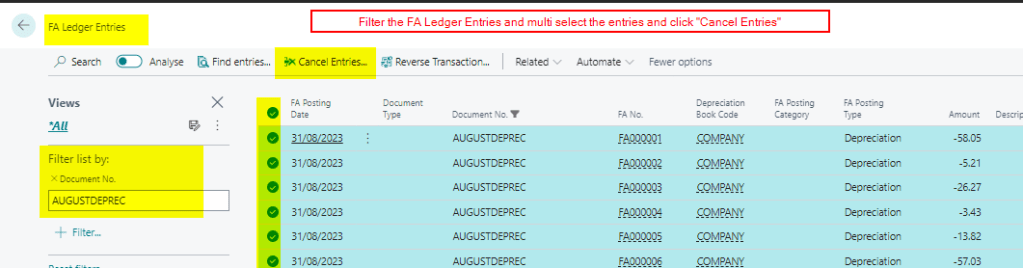
One way I could resolve this is to go the “FA Ledger Entries” page and filter for the entries I wish to cancel and click “Cancel Entries”.

For example, below I’ve filtered on the “AUGUSTDEPREC” document number and then selected all the entries and clicked “Cancel Entries”.

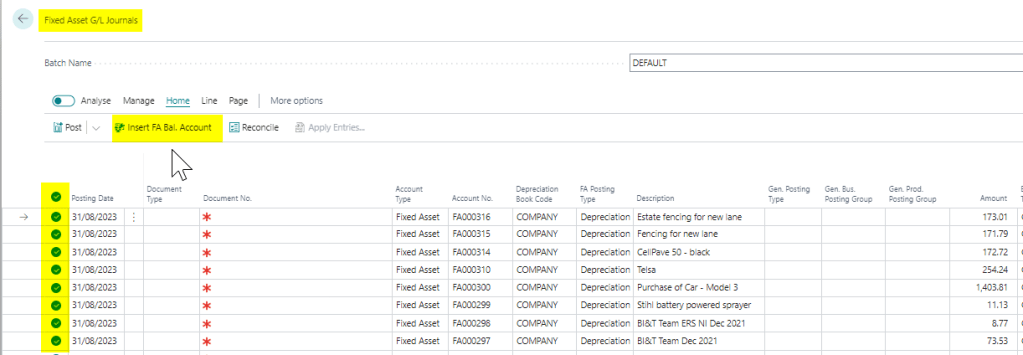
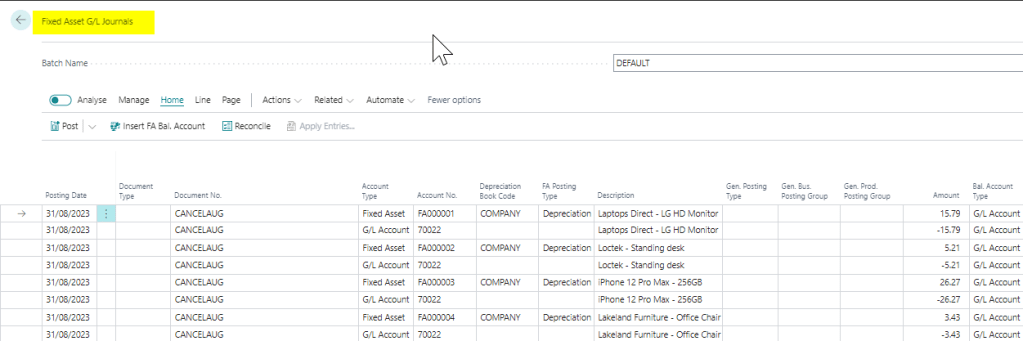
Although this would create me a Fixed Assets G/L Journal to cancel the entries, it wouldn’t automatically populate the balancing account. I’d then have to open the “Fixed Asset G/L Journal” page and highlight all the rows and click “Insert FA Bal Account”

I could then post the journal which would cancel the entries.

Option 2 – Use “Cancel FA Ledger Entries” on the Depreciation Book

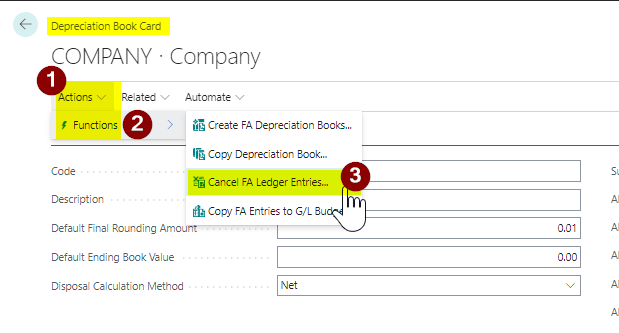
I find that another, more efficient way of doing this, would be to use the “Cancel FA Ledger Entries” function on the Depreciation Book.

To do this search “Depreciation Book”, select the relevant Depreciation Book, and then click to edit it. Next, select the option “Actions > Functions > Cancel FA Ledger Entries”

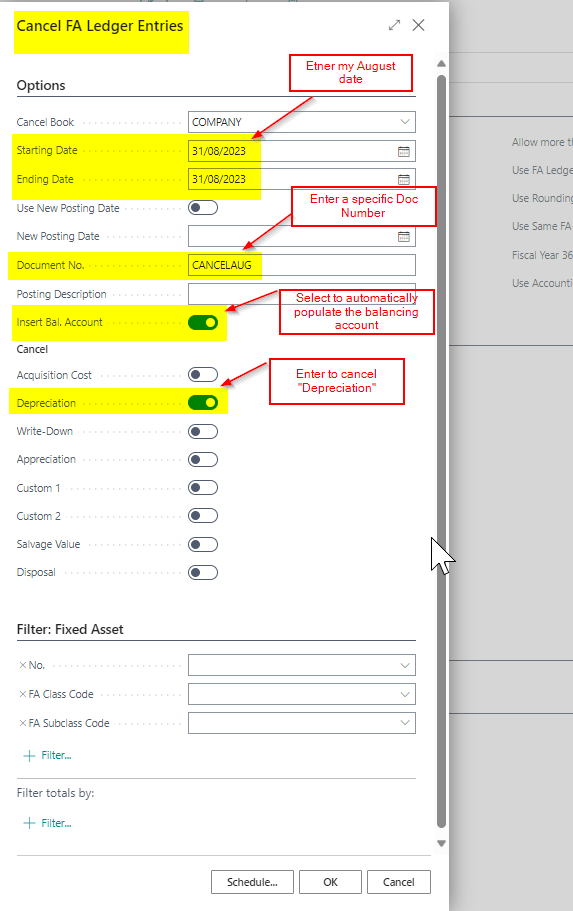
This will open a dialog box with various options for cancelling different types of Fixed Assets transactions including Depreciation.

I’ll therefore choose the options below and click OK.

Using this method, I’m sure to cancel all depreciation entries within the specified date range. Additionally, it allows me to include the balancing account and specify a document date, all conveniently on a single page.

This will then create the relevant Fixed Asset G/L Journal I can post to cancel the entries

Final Note

When you choose to “Cancel” entries although all entries are reversed, including GL entries, they don’t appear in the “FA Ledger Entries” page. (this includes the FA Ledger Entry you cancelled). They can be viewed via the “FA Error Ledger Entries” page. This is by design as the entries have been cancelled.

Conclusion

There are various methods available for cancelling Fixed Assets entries. However, when I need to cancel multiple entries simultaneously, such as monthly depreciation, I prefer using the “Cancel FA Ledger Entries” page. When cancelling individual entries, I find the “Cancel FA Entries” option on the “FA Ledger Entries” page to be more convenient.

Thanks for reading!