Dynamics 365 Business Central – How I post opening balances for the General Ledger in Business Central

Introduction

In previous posts I’ve looked at how I post opening balances for various modules in Business Central. Links to these articles can be found below:

Today I wanted to discuss how I post opening balances for the General Ledger. (I perhaps should have started with this one 😀)

I use a couple of approaches when posting opening balances for the General Ledger, choosing the method based on the level of transactional detail required. In this post I’ll discuss all three methods including which one I commonly recommend and why.

Please note in all the methods described below, right after posting the opening balance journal, I print and save a copy of the General Ledger Trial Balance. I also make a note of the G/L Register from the “G/L Register” page in Business Central. (although I name the batch OPENBAL-GL so its easy to spot anyway)

Preparation

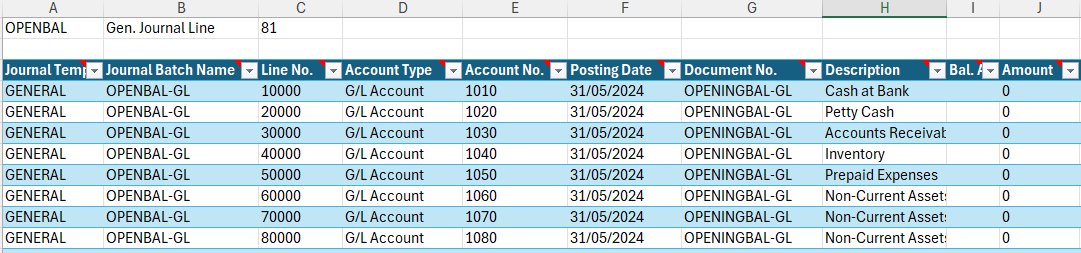
For all the methods, I use a predefined configuration package that I export to Excel, ask the client to populate with data, and then import back into Business Central.

This includes key fields like the Posting Date, Account Number, Dimensions, and Amounts. A copy of the configuration package can be found here along with other free stuff 😊

A screen shot of Excel Spreadsheet is below:

Example of Excel Template for Opening Balances

Method 1 – Post Total Opening Balances as of Go Live Date

This method involves posting the balance of each General Ledger code in one journal, using one document number, on the required go live date.

Therefore if you were going LIVE with Business Central on the 31st of May 2024 you’d collect your General Ledger balances as of this date from your existing system and populate the Excel Spreadsheet with this data.

Important considerations should be given to the control accounts such as the Sales and Purchase control account to ensure these balance to any imported Sales and Purchase Ledger transactions.

Once the journal has been imported, and you are happy with the balances, you can post the journal to record the opening balances.

This is the quickest and easiest way to post opening balances for the General Ledger, but it has limitations. The primary drawback is the lack of historical financial reporting in Business Central. In contrast, Method 2, while more time-consuming, provides greater detail.

Method 2 – Post Total Opening Balances and Period Balances

This method involves posting opening balances for a set period prior to your go-live date and then posting additional period balances up to the go-live date, resulting in a final go-live balance.

For example, if you plan to go live with Business Central on 31st of May 2024, and want 12 months’ worth of summary information prior to this, you would post an opening position as of 31st of May 2023, using a document number like “OPENBAL-GL-MAY23.” Then, you would post balances for each of the 12 monthly periods from June 2023 through May 2024 using different document numbers, such as “PERIODBAL-GL-JUN23” and “PERIODBAL-GL-JUL23.” all building up to a total balance as of May 2024.

This approach allows you to report month-on-month using only Business Central data as soon as you start using the system. For instance, after being live with Business Central for June 2024, you could compare June 2023 data to the live data for June 2024.

Method 3 – Posting Opening Balances and Detailed Information

The final method can only realistically be used when the company is very small and doesn’t have lots of transactions.

This method involves posting an opening position followed by the detail information for a set period of time.

For example if your year end is 31st of December 2023 and you wanted to go live with Business Central as of 31st of May 2024 you could post the opening balance from your existing system as of the 31st of December 2023 and then enter each transaction manually from 31st of December 2023 to the 31st of May 2024. (in this scenario it doesn’t really matter when you go live as you are entering detailed information from the 31st of December 2023)

As you can imagine this is the most labour intensive method so is generally only used on companies with few transactions.

** You also have to post opening balances for the sub ledgers as of 31st of December 2023 and then enter detail information. This can be very labour intensive if there are lots of transactions.

Conclusion

All methods provide a solution for posting opening balances into Business Central. I prefer to use Method 2 because, although it requires a bit more effort, it allows for comparison reporting as soon as you go live with Business Central.

Thanks for reading!

Want further help with Business Central?

If you’d like more help with Business Central, I also run Rapid365, which provides Business Central implementation and support services for UK businesses, supporting you through setup and go-live.

👉 View services and pricing at Rapid365.co.uk/pricing

Dynamics 365 Business Central – A couple of methods I use when posting opening balances for Sales and Purchase Ledger

Introduction

In previous posts I’ve looked at how I post opening balances for Fixed Assets, Expected Costs and Bank Accounts. Links to these articles can be found below:

Today I wanted to discuss how I post opening balances for Sales and Purchase Ledger.

The post will focus on opening balances for Sales Ledger, however I follow the exact same process for Sales and Purchase Ledger.

I used to stick with one tried and trusted method however I recently encountered an issue which has made me reassess and try something new.

I’ll detail both methods below including the issue I recently encountered with the first method.

Preparation

In order to prepare for the opening balances, there’s a couple of very important things to check and do.

Firstly, unless there are exceptional circumstances, I will only bring in outstanding Sales Ledger transactions, therefore I always recommend applying all open invoices, credits, payments in the source system. I then ask the client to ensure the debtors report balances to the General Ledger Accounts Receivable code.

Once everything is reconciled in the source system, I provide a data pack in the form of a Excel spreadsheet for the client to complete with their Sales Ledger opening balance transactions that can be easily imported into a General Journal via a configuration package.

I also include a “Readme” sheet as part of the Excel spreadsheet. This has more information on each column included in the data pack, to make this easier for the client to complete. A snippet of the readme is shown below however you can download the Excel Sheet from here along with other Free Stuff 🙂

Its also worth noting the General Ledger opening balances for the Accounts Receivable and Accounts Payable is posted separately via the GL Opening Balance Trial Balance.

Method 1 – Balance every entry to the Accounts Receivable code

Method one involves importing the data pack into a General Journal and then balancing each Sales Ledger opening balance entry (i.e. open Invoice, Credit, Payment etc) to the Accounts Receivable control account. This produces GL entries that will both Debit and Credit the same Accounts Receivable control account. (I do this as the Accounts Receivable opening balance is posted as part of the General Ledger opening balances).

After everything is posted I’ll then check the “Aged Accounts Receivable” report balances to the General Ledger Accounts Receivable code.

For example in the demo company below the Accounts Receivable GL account is 1030 and has a posted opening balance of £12,500.00

Therefore I import the Sales Ledger opening balances from the data pack into a General Journal and then ensure each entry balances to GL code 1030 and the total balances to £12,500.00.

When posted every entry then Debits and Credits the GL Code 1030 making no effect to the GL balance.

As a final check, after posting the opening balance I run the “Aged Accounts Receivable” report and ensure it balances to £12,500.00 and therefore matches the General Ledger balance.

At the end of the process I have a balance on the General Ledger for GL code 1030 of £12,500.00 and a balance on my Sales Ledger of £12,500.00.

Therefore everything balances 🙂

** There is a slight flaw with this which I’ll detail after Method 2 **

Method 2 – Balance every entry to a Suspense Code

The next method follows the same process except you balance each entry to a Suspense Account.

You then add an additional line that reverses the balance in the Suspense Account to the Accounts Receivable GL Code

The GL Entries for both the Accounts Receivable and Suspense net off to £0.00.

The final check would be to ensure the “Aged Accounts Receivable” report matches the Accounts Receivable GL balance just like Method 1.

Issue with Method 1

The issue with method one arises if someone reverses one of the Sales Ledger opening balance entries.

If this happens the GL entries debit and credit the Accounts Receivable GL code, as these were the original entries, which causes an imbalance between the GL and the “Aged Accounts Receivable” report (as the transaction drops off this report).

I’ve historically found this a tricky issue to spot and resolve without significant manual reconciliation.

If you were to reverse an opening balance entry posted using Method 2 this wouldn’t the case. The Suspense Account would be affected, as well as the Accounts Receivable account. Therefore the Aged Accounts Receivable would still balance, and you could also easily spot an issue as the suspense account would have a balance.

Conclusion

Both methods offer good solutions for importing and posting opening balances for both Sales and Purchase ledger opening balances.

Although the issue with Method 1 doesn’t happen often its something to be aware of as it can cause issues following a go live.

Thanks for reading!

Want further help with Business Central?

If you’d like more help with Business Central, I also run Rapid365, which provides Business Central implementation and support services for UK businesses, supporting you through setup and go-live.

👉 View services and pricing at Rapid365.co.uk/pricing

Dynamics 365 Business Central – Why do I have the popup “General Journal Template List” when opening the General Journal page

Introduction

A client reported different behaviour when accessing the “General Journal” page across their various companies in Business Central.

When searching and selecting “General Journal” in one company, it opened the “General Journal” page immediately. However, in another company, they were presented with a “General Journal Template List” page. At this point, they had to select a template, before they could being entering the journal.

In this post, I’ll show why the companies are exhibiting different behaviour when trying to do the same task.

The Pop Up

In one company, when searching and selecting “General Journal” they are presented with the “General Journal Template List” page below:

This differs from the other company, which immediately takes them into the “General Journal” page so they can begin entering journals.

More on General Journal Templates

The clue for why this is happening lies in the heading of page that pops up – “General Journal Template List”.

Although we don’t have much interaction with General Journal Templates, one exists for each type of Journal that you can create (i.e. Payment Journal, Cash Receipt Journal, General Journal etc), providing default information for all their journal batches.

For example, a General Journal Template exists for journals that are entered via the “Payment Journals” page, one exists for journals that are entered via the “Cash Receipts Journals”, one exists for Journals entered via the “General Journal” page and so on.

The batches into which journals are entered are specific to the General Journal Template. Incidentally, this explains why a batch created in a “General Journal” page isn’t visible in the “Payment Journals” page, and vice versa.

The Issue

As the pop up is asking us to select a “General Journal Template”, the answer to the issue must lie in how these are configured.

I therefore open the “General Journal Template” page and spotted someone had created an additional template of Type “General”.

After a little digging, it appears a new user had mistakenly created the “GENERAL2” template when trying to create a new batch.

To resolve the issue I simply deleted the duplicate General Journal Template and the pop up has now disappeared.

Conclusion

While it’s technically possible to have multiple General Journal Templates for each Type, it’s not typically considered standard practice.

Rather than creating multiple General Journal Templates, its generally recommended to create multiple batches within each Template.

Thanks for reading!