Dynamics GP Vs Dynamics 365 Business Central – Managing Financial Periods

Introduction

Dynamics GP and Dynamics 365 Business Central both have great options to manage financial periods therefore controlling what date ranges users can post into.

In this post I’ll explore how this is achieved in both products, and point out what I think are the key benefits of each solution.

Dynamics GP

In Dynamics GP you can open and close financial periods using the “Financial Period Setup” window as per below
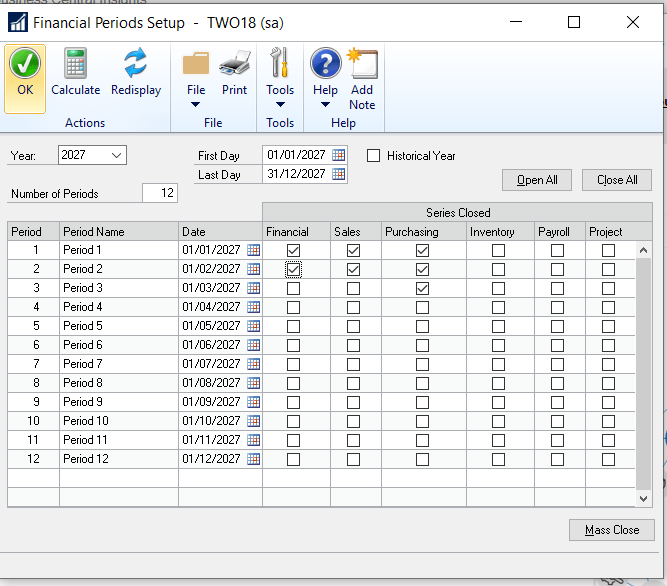
There’s a couple of key takeaways here:

  1. This is a global setting therefore the configuration of this window affects all users of the system. i.e. you can’t allow some users to post into certain periods on an individual basis.
  2. You can close the financial period for one series, (or ledger) while leaving another series open. For example, in the configuration above you can post a Sales transaction with a GL posting date of March, however you can’t post a Purchasing transaction with a GL posting date of March as that has been closed.

Dynamics 365 Business Central

In Dynamics 365 Business Central you can control allowed posting dates in two separate places.

The first is by entering a specific date range in the General Ledger Setup as per below.
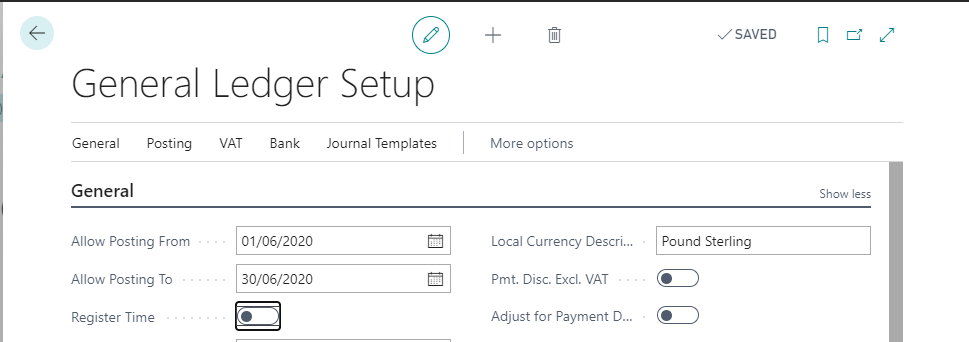
The next is at user level via the User Setup window:
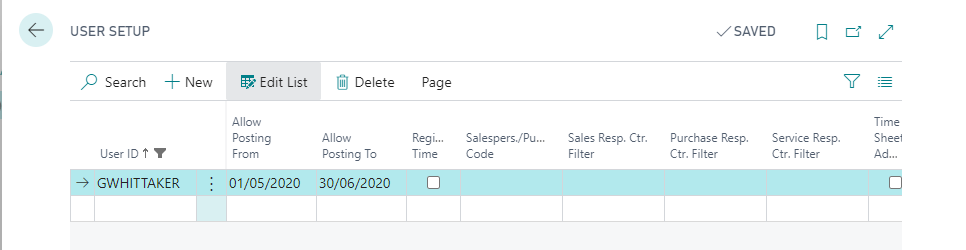
If you haven’t specified a user as having a different “Allowed Posting Date” range in the User Setup window then they are bound to the allowed posting dates in the General Ledger Setup.

The key takeaways here are:

  1. You can have different allowed posting dates for different users.
  2. You can’t completely close one series (ledger) and have another still open.

Conclusion

I think both systems have great features.

I love the way you have the flexibility to only close down certain series (ledgers) in Dynamics GP, as I imagine in the real world departments aren’t ready to close at the same time.

I also like how in Dynamics 365 Business Central we can close a financial period using the “General Ledger Setup” window for the majority of users however you can configure some users, for example a financial controller, to have the flexibility of posting across a larger date range.

Perhaps one day one of the products will incorporate both ideas 🙂

Thanks for reading!

Thinking of making the move to Business Central? We can help

Dynamics GP – How to Unapply a Payables Invoice in HISTORY that’s applied to a OPEN Credit Document

Scenario

I often see this request via support so thought I’d document it on my blog. The question varies however it usually goes something like this:

“I’ve accidentally applied an invoice to a Payment and now I need to unapply this however when I select the Payment in the “Transactions > Purchasing > Apply Payables Document” window the Invoice isn’t available to unapply? How can I unapply the invoice?”

The issue here is the “Apply Payables Document” window only shows OPEN documents and as the invoice has been fully applied its now in HISTORY. Therefore you can’t unapply it via this window.

Please note if both documents were in OPEN you could use the “Transactions > Purchasing > Apply Payables Documents” window to unapply it.

The solution in summary

Unfortunately there’s no easy way to unapply the invoice in this situation.

The fix I often suggest is to apply a dummy transaction to the payment so that it’s also transferred to HISTORY. You can then void the payment, which will unapply the Invoice.

Therefore, in summary, the steps would be:

  1. Post a dummy invoice (or debit note) for the amount remaining on the payment.
  2. Apply the dummy invoice to the payment which will send the payment to HISTORY.
  3. Void the payment via “Transactions > Purchasing > Void Historical Transactions”. This will unapply the Invoice.
  4. Void the dummy invoice via “Transactions > Purchasing > Void Open Transactions”
  5. Post the voided Payment back onto the system.

Detailed solution with an example

I’ve also described the scenario and solution in detail below.

Invoice INV123 has been accidentally applied to Payment 20069 when it should have been applied to Payment 20070. As a consequence Invoice INV123 is in HISTORY but Payment 20069 is still in OPEN meaning the invoice can’t be easily unapplied

This image has an empty alt attribute; its file name is image.png

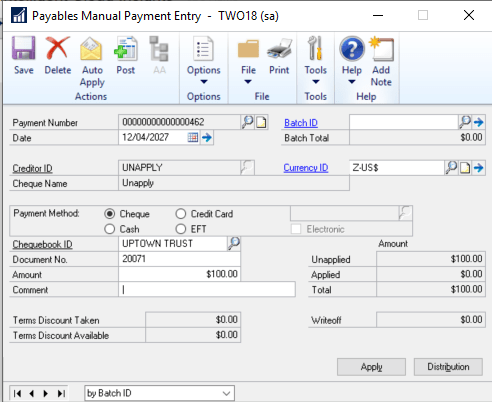
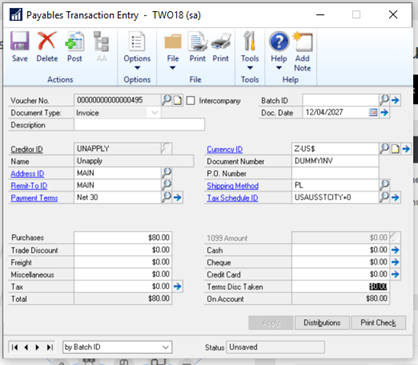
To fix this we first post a dummy invoice for $80.00 (the remaining amount of payment 20069):

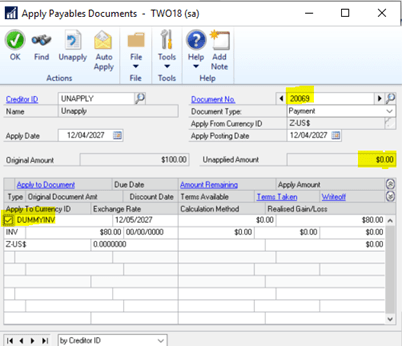
Next we apply this to the Payment via “Transactions > Purchasing > Apply Payables Documents”:

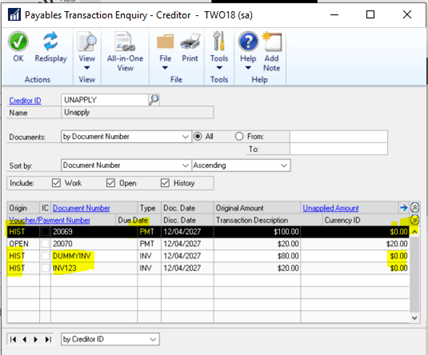
Now the Payment and invoices all show in History:

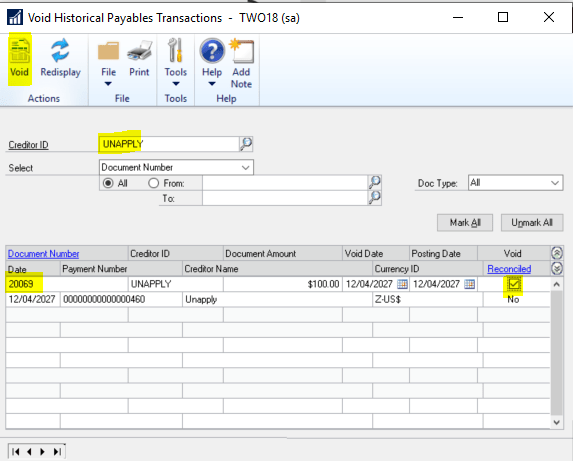
Next we void the payment via “Transactions > Purchasing > Void Historical Transactions”

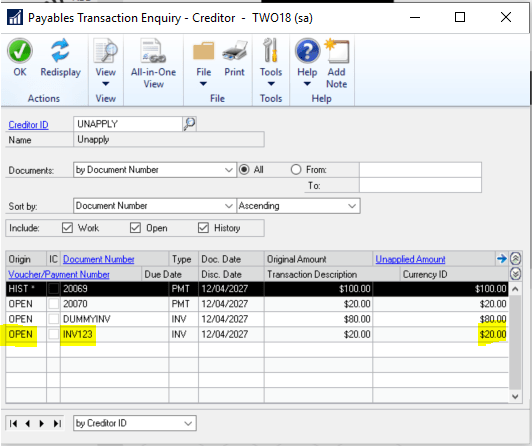
Invoice INV123 is now showing as unapplied (as is the dummy invoice):

We now void the dummy invoice via “Transactions > Purchasing > Void Open Transactions”

And finally post the payment back onto the system

Once this has been done you can go ahead and apply invoice INV123 to the correct payment.

Conclusion

Although there are many steps to unapply the invoice using this process, it does provide a way of unapplying the invoice.

I hope this helps someone in the future.

Thanks for reading!

Thinking of making the move to Business Central? We can help
Dynamics 365 Business Central – How to Post a VAT only Invoice

Although not a regular occurrence, from time to time users need to post a VAT only invoice onto the sales or purchase ledger. If this happens below are the steps you can take to do this:

Please note these steps are specifically for a Purchase Invoice however it should work the same for a Sales Invoice.

Step 1: Add a new VAT Product Posting Group

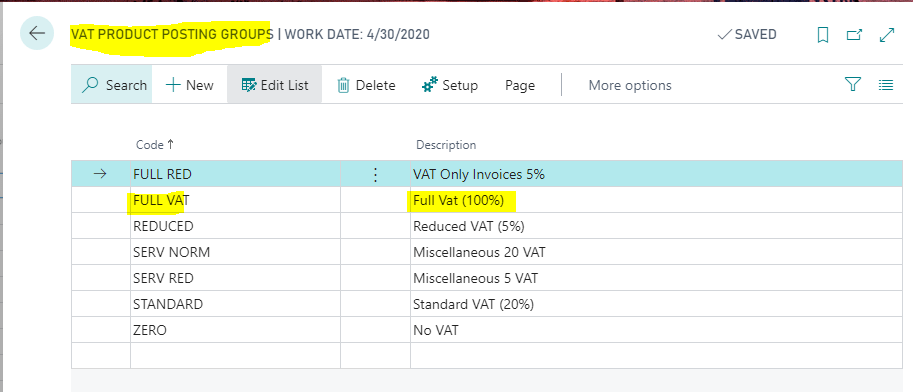
First go to “VAT Product Posting Group” and add a new VAT Product Posting group for FULL VAT as per below

Step 2: Configure VAT Posting Setup

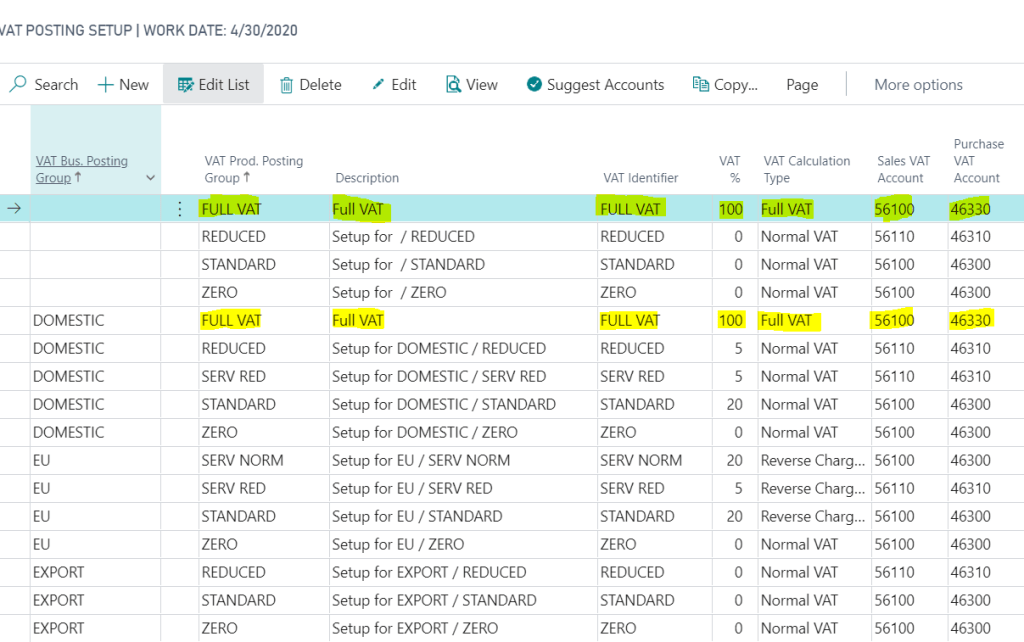
Next we need an additional FULL VAT entry in the “VAT Posting Setup” matrix as per the screen shot below. I’ve included FULL VAT twice, once with a blank “VAT Bus. Posting Group”, and once with a “VAT Bus. Posting Group” of DOMESTIC.

Please note I’ve set the system up this way so if entering a VAT only invoice via a “Purchase Journal” I only have to populate the “VAT Prod. Posting Group” whereas if I were to enter the invoice via “Purchase Invoice” its likely the supplier would have a “VAT Bus. Posting Group” of DOMESTIC. Setting the system up this way covers both scenarios.

Step 3: Entering the VAT only invoice via a “Purchase Journal” window.

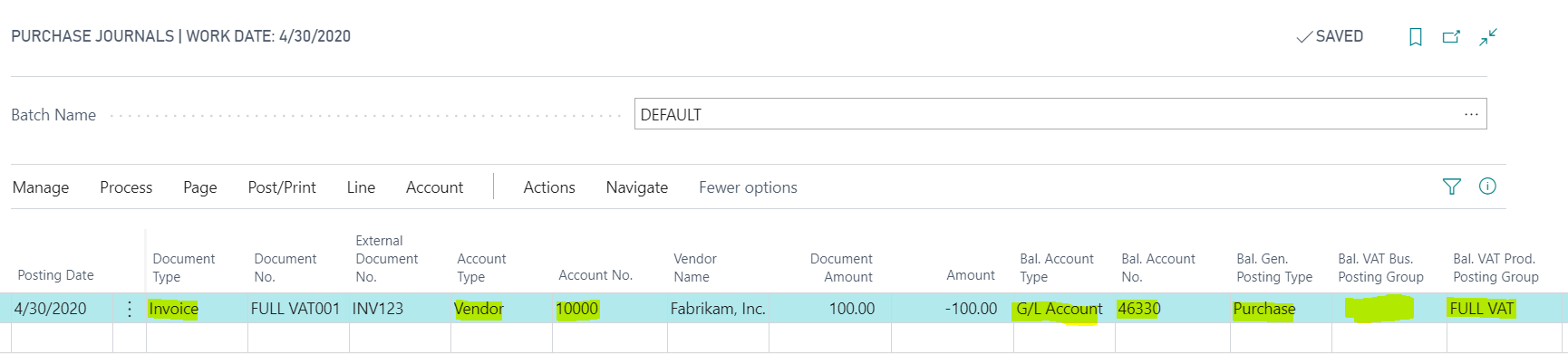
In this example I’m entering a ÂŁ100.00 VAT only invoice via the “Purchase Journal” window.

To do this I’ve entered the invoice details as follows:

Just to confirm, I’ve selected a document type of “Invoice” and the Vendor account of “1000”. Then for the “VAT only” element to work I’ve selected the following for the various columns:

Bal. Account Type = G/L Account

Bal Account No. = 46330 (this is the VAT account specified in the VAT Posting Setup)

Bal. Gen Posting Type = Purchase

Bal. VAT Bus. Posting Group = BLANK (I could select DOMESTIC as well if I like)

Bal. VAT Prod. Posting Group = FULL VAT

Please note using the “VAT Posting Group” setup outlined in my screen shot above a combination of a blank “VAT Bus. Posting Group” and a “VAT Prod. Posting Group” of “FULL VAT” equates to 100% full VAT

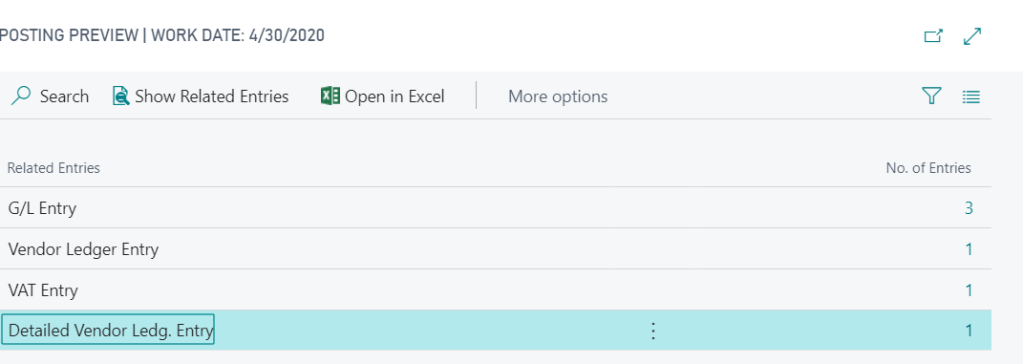
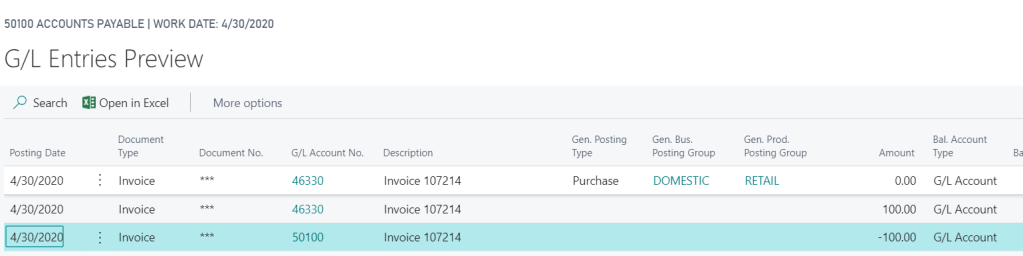
If I now preview the posting on this transaction I can see 3 G/L Entries and one VAT entry:

If I drill down on the G/L Entries this shows the full amount posting to the VAT control account specified in the VAT Posting Setup. (as this is a Purchase Invoice the credit side goes to the Creditors Control Account):

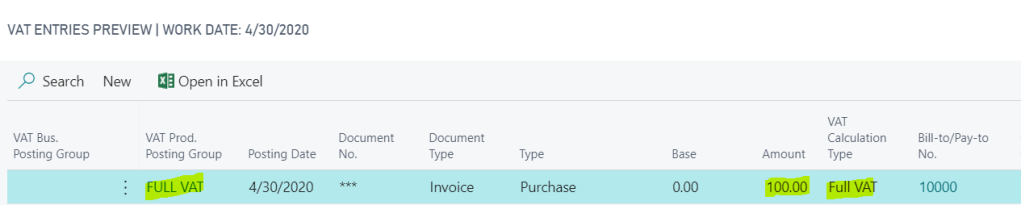
And when I drill back on the VAT entries I can see a VAT entry for the full amount:

Step 4: Entering the VAT only invoice via the “Purchase Invoice” option

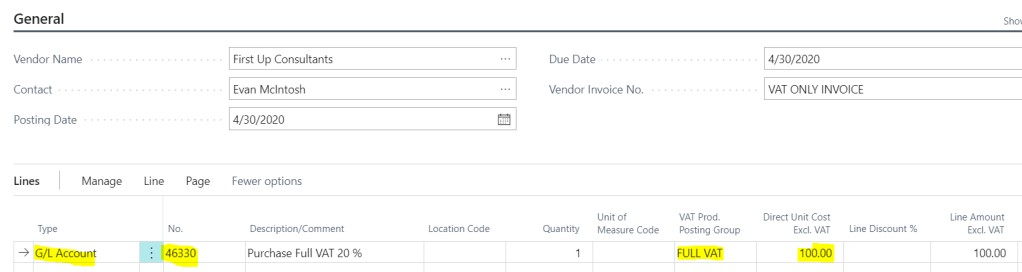
Once in the “Purchase Invoice” page I enter the invoice line as per below.

To confirm, I’ve entered the line as per below:

Type = G/L Account

No. = 46330 (this is the VAT account specified in the VAT Posting Setup)

Vat Prod. Posting Group = FULL VAT

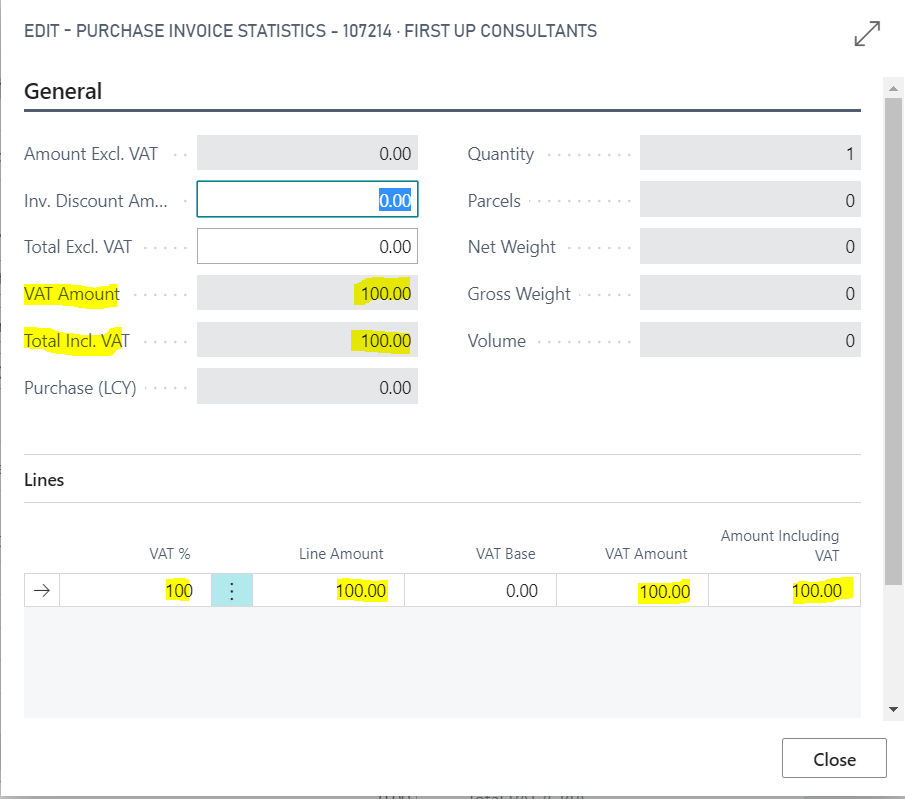
Now when I check the “Statistics” on the invoice it shows the full amount to VAT:

Also, when I preview the posting I can see G/L entries to the VAT account and a VAT Entry of the full amount:

Step 5: Ensure FULL VAT is included on the VAT Statement

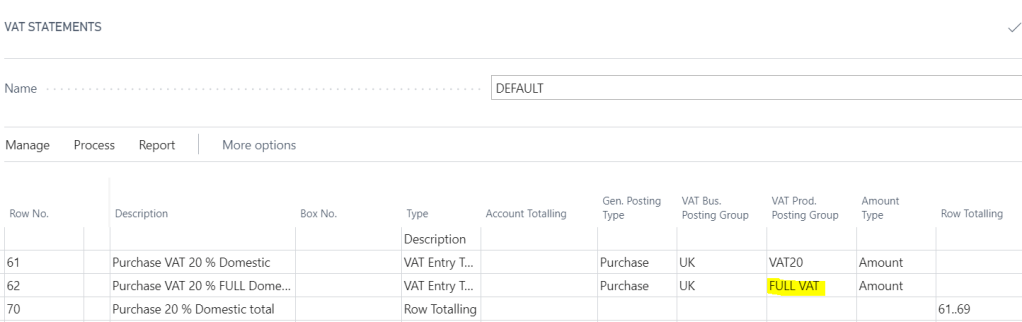
Once you have posted the transaction you should also ensure the new “VAT Prod. Posting Group” (i.e. FULL VAT) is included on the VAT statement so any transactions posted to this are picked up correctly when reporting the VAT.

As you can see below I’ve included this in the Purchases section:

I hope this helps anyone who needs to post a VAT only invoice in Dynamics 365 Business Central.

Thanks for reading!